
Where Does "Here Comes the Bride" Come From?

In this guide
"Here Comes the Bride" is the Bridal Chorus from Richard Wagner's opera Lohengrin, first staged in 1850. In the opera it is not an entrance march at all: the wedding guests sing it after the wedding, as they lead the couple to their bedroom. Then the marriage falls apart before the night is out.
This is the long version of our "Wedding myths" video, including the royal wedding that usually gets the credit, and what the official record says actually happened.
Wagner's Lohengrin, Act III
Lohengrin had its premiere in Weimar on 28 August 1850, conducted by Franz Liszt. The wedding of Elsa and the mysterious knight Lohengrin happens offstage between the second and third acts. Act III opens with the guests leading the two of them to the bridal chamber, singing "Treulich geführt", which means roughly "faithfully led". That is our tune.
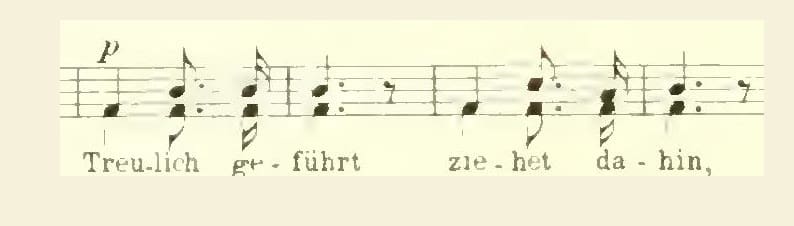
The opening of the Bridal Chorus, "Treu-lich ge-führt", in a 1914 Edition Peters vocal score of Lohengrin. Via the Internet Archive, public domain.
So there is no aisle and no bride walking towards anyone. It is music for after the ceremony, on the way to bed.
The wedding night
Before the wedding, Lohengrin has made Elsa promise never to ask his name or where he comes from. Alone with him in the bridal chamber, she asks. At that moment a rival, Telramund, bursts in to attack Lohengrin, and Lohengrin kills him. Lohengrin then reveals who he is, a knight of the Holy Grail, and leaves for ever. Elsa collapses and dies.
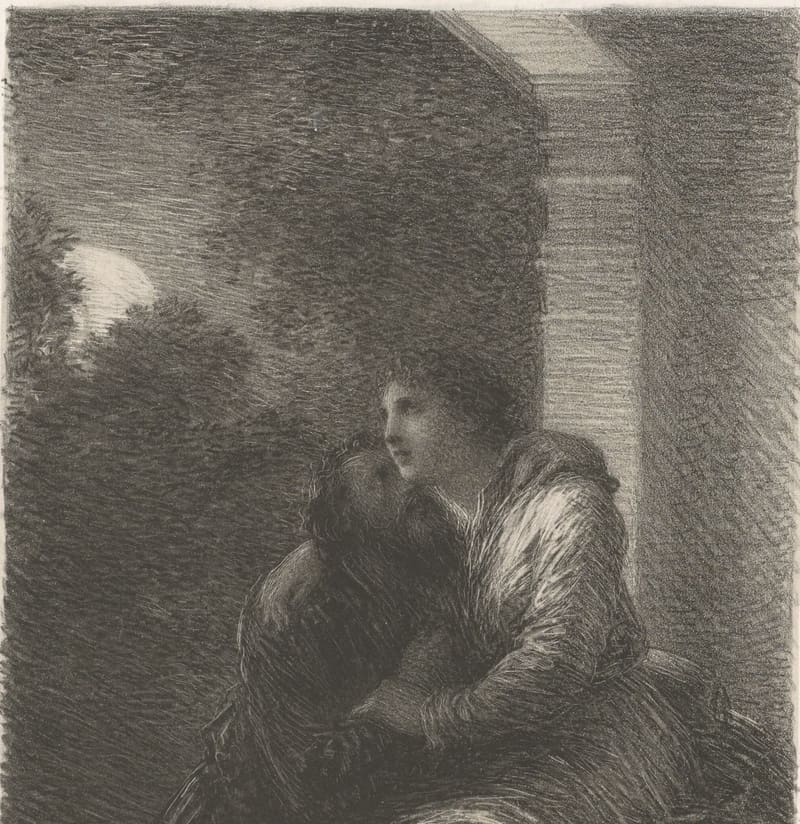
Lohengrin, Acte III, Scène d'amour, lithograph by Henri Fantin-Latour, 1886: the couple alone, just before it all goes wrong. Boston Public Library via Wikimedia Commons, public domain.

Which makes it a slightly odd thing to walk down the aisle to.
The royal wedding that gets the credit
The usual story is that the Bridal Chorus became the wedding march in 1858, when Queen Victoria's eldest daughter, Victoria, the Princess Royal, married Prince Frederick William of Prussia (later the German Emperor). Wikipedia's article on the Bridal Chorus repeats it: that the piece was made popular when it was used as the processional at that wedding.
The official account says otherwise. The London Gazette printed the order of the ceremony the following week, and it records the music as she came in:
On arriving at the Chapel, the Drums and Trumpets filed off as before, and as The Bride entered the Chapel, a March, from Handel's Oratorio of "Judas Maccabeus," was played by Her Majesty's Band.
And on the way out:
At the conclusion of the Service the Park and Tower Guns fired, and as the Procession left the Chapel, the Wedding March, from Mendelssohn's "Midsummer Night's Dream," was played.
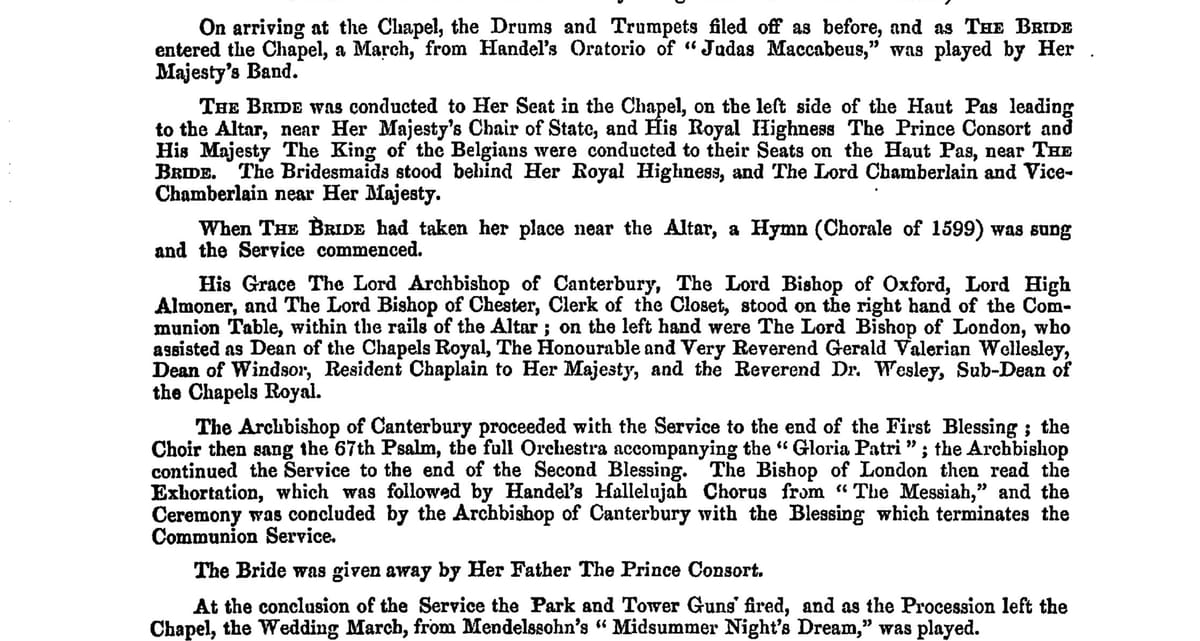
Supplement to the London Gazette, 2 February 1858, page 480 (detail). Recorded in The Gazette (London Gazette), issue 22089. Contains public sector information licensed under the Open Government Licence v3.0.
So she walked in to Handel. The organist's own diary agrees: Sir George Smart, quoted by the musicologist Matthias Range, noted "the Band playing the March in 'Judas Macc:'".
Wagner was not in the chapel at all. According to Range, the Bridal Chorus was performed that evening, as part of a selection from Lohengrin at a special concert at Buckingham Palace. That is probably how the two got tangled up.
So how did it become the wedding march?
Slowly. The earliest ordinary wedding Range could trace with the Bridal Chorus in it was at Fairfield, near Liverpool, in September 1875, where the organist played it during the signing of the register (and Mendelssohn as the party left). That is the earliest found so far, not necessarily the first.
The English name may come from a 1915 American silent film called Here Comes the Bride, which Range mentions with the caveat that the details still need study. Wagner's own words, again, are "Treulich geführt".
What we're not claiming
- That nobody should play it. It is the standard bridal march in Britain and America and it is lovely. Only the story of how it got there is wrong.
- That Mendelssohn wasn't at the 1858 wedding. He was, at the exit. The Gazette lists both.
- That the royal wedding was the first time Mendelssohn's march was used at a wedding. Probably not: a Devon wedding in 1847 is reported to have used it. But this was the famous one.
- Exactly how it was performed at the concert. One source says an organ arrangement, another that the choir probably sang it. We just say performed.
- That Lohengrin is murdered. He isn't. He kills Telramund, then leaves, and Elsa dies.
- The 1915 film as fact. It is one researcher's lead, and he flags it himself.
A note from us
We built Quiz Your Guests for our own wedding, and facts like these make good questions between the rounds about the couple. You can write your own multiple choice questions, one right answer and three wrong ones; guests scan a QR code, answer on their phones in two teams, and the scoring happens by itself. There is a printable wedding quiz too, if paper suits your day better.
More wedding myths
- Who started the white wedding dress?
- Where does the word honeymoon come from?
- Why does the groom carry the bride over the threshold?
- Why did eloping couples race to Gretna Green?
- Where does "a month's salary on the ring" come from?
Sources
- Supplement to the London Gazette, 2 February 1858, p. 480
- Matthias Range, "Wagner's 'Bridal Chorus' from Lohengrin and its Use as a Wedding March", Journal of the Royal Musical Association 148/1 (2023), open access
- Wikipedia, Bridal Chorus and Lohengrin
- OUP blog (2012), on the 1858 wedding music and the evening concert
Skip the spreadsheet
Everything in this guide — timed rounds, team scoring, escalating points — is built into Quiz Your Guests. Answer four questions and your quiz arrives already written and scheduled around your day.
Ready to run yours?
Your quiz arrives written, themed and timed around your day — free to try, no signup needed.
Create your wedding quiz →Keep reading