
Why Does the Groom Carry the Bride Over the Threshold?

In this guide
The oldest explanation we have for carrying a bride over the threshold is Roman, and it is not about luck or evil spirits. Around AD 100 the writer Plutarch said Roman brides were lifted into their new home because the first Roman brides, the Sabine women, were carried off by force. And according to Plutarch, it wasn't even the groom who did the lifting.
This is the long version of our "Wedding myths" video, with Plutarch's own words.
The custom is Roman
Plutarch was a Greek writer who lived from about AD 46 until some time after 119 and wrote a great deal about Rome. In his life of Romulus, the legendary founder of Rome, he describes the custom as something still done in his own day:
And it continues to be a custom down to the present time that the bride shall not of herself cross the threshold into her new home, but be lifted up and carried in, because the Sabine women were carried in by force, and did not go in of their own accord.
That is from the Loeb translation by Bernadotte Perrin, 1914. Karen Hersch's history of the Roman wedding, as summarised in a review, agrees that a Roman bride "was at some point carried across a threshold", though she notes it is unclear whether that meant the threshold of the house or of the bedroom.
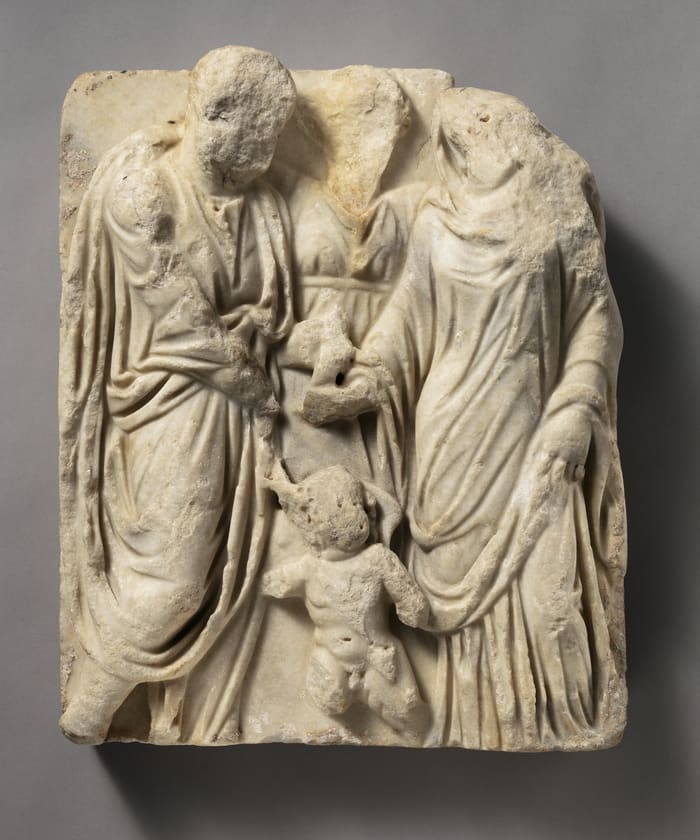
A Roman wedding scene on a marble sarcophagus fragment, early 3rd century AD. The Metropolitan Museum of Art, CC0.

The Sabine women
The story behind it is Rome's founding legend, set in the city's legendary first years. Romulus's men needed wives, so the Romans held a festival, invited the neighbouring Sabines, and carried off their daughters.
It is a legend, not history, and a grim one. But it is the legend the Romans themselves used to explain the custom. Plutarch even says the wedding shout "Talasius!" came from the same raid, and that some say parting the bride's hair with the head of a spear is "a reminder that the first marriage was attended with war and fighting".
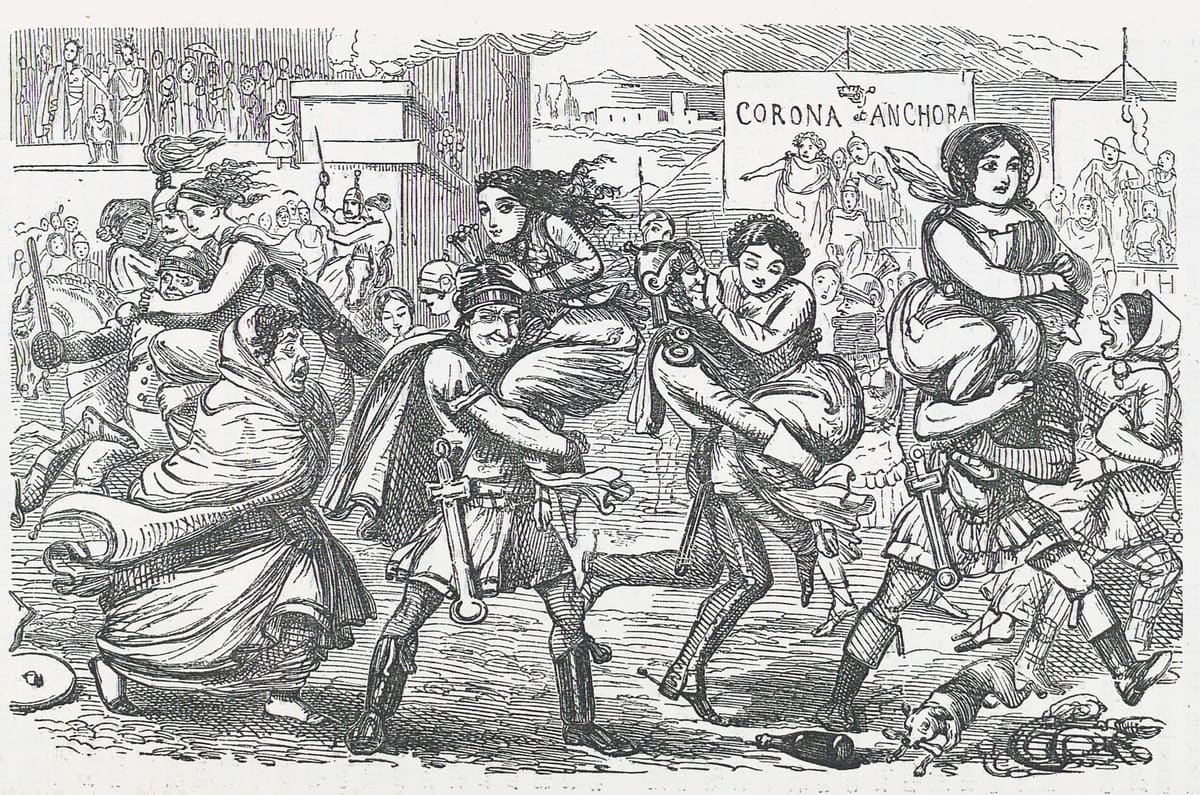
"The Romans walking off with the Sabine Women", John Leech, from The Comic History of Rome, around 1850. Victorian readers found the story funnier than we might. Via Wikimedia Commons, public domain.

Plutarch wasn't completely sure either
In a different book, the Roman Questions, Plutarch asks the question directly and gives three possible answers:
Why do they not allow the bride to cross the threshold of her home herself, but those who are escorting her lift her over? Is it because they carried off by force also the first Roman brides and bore them in in this manner, and the women did not enter of their own accord? Or do they wish it to appear that it is under constraint and not of their own desire that they enter a dwelling where they are about to lose their virginity? Or is it a token that the woman may not go forth of her own accord and abandon her home if she be not constrained, just as it was under constraint that she entered it?
That is the Loeb translation by Frank Cole Babbitt, 1936. The Sabine answer comes first, and it is the only one he gives in the life of Romulus, which is why we call it the oldest explanation.
He adds a version from his own part of Greece that we rather like: "So likewise among us in Boeotia they burn the axle of the bridal carriage before the door, signifying that the bride must remain, since her means of departure has been destroyed."
The twist: it wasn't the groom
Look at the first line of that question again: "those who are escorting her lift her over". In Plutarch's account the bride is lifted in by the people who walked her to the house, her escorts, not her new husband.

Plutarch, The Roman Questions 29, in Moralia vol. IV, Loeb Classical Library (1936), page 51. University of Toronto copy via the Internet Archive, public domain.
So the groom carrying her himself may well be a later version. Sweep her off her feet? The Romans meant it literally, and they had help.
What we're not claiming
- That the Sabine abduction happened. It is a legend. Our claim is that Romans explained the custom with it.
- That Plutarch had only one reason. He offers three. The Sabine one is the one he gives in both books.
- That a Roman groom never carried his bride. We have one sentence saying her escorts lifted her. That is the evidence; it does not rule out every Roman wedding.
- That today's custom descends in a straight line from Rome. Our sources don't trace the path from Rome to modern Britain. The Romans did it too, and this is how they explained it.
- That nobody ever connected it with evil spirits. Later writers may have. We only say the oldest explanation on record doesn't mention them.
- Which threshold. Plutarch says the threshold of her home. Hersch points out it may have been the bedroom.
A note from us
We built Quiz Your Guests for our own wedding, and facts like these make good questions between the rounds about the couple. You can write your own multiple choice questions, one right answer and three wrong ones; guests scan a QR code, answer on their phones in two teams, and the scoring happens by itself. There is a printable wedding quiz too, if paper suits your day better.
More wedding myths
- Who started the white wedding dress?
- Where does the word honeymoon come from?
- Where does "Here Comes the Bride" come from?
- Why did eloping couples race to Gretna Green?
- Where does "a month's salary on the ring" come from?
Sources
- Plutarch, Life of Romulus 15, trans. Bernadotte Perrin (Loeb, 1914), LacusCurtius and Internet Archive
- Plutarch, The Roman Questions 29, trans. Frank Cole Babbitt (Loeb, 1936), LacusCurtius and Internet Archive
- John H. Oakley, review of Karen K. Hersch, The Roman Wedding: Ritual and Meaning in Antiquity (CUP, 2010), Bryn Mawr Classical Review 2011.03.62
Skip the spreadsheet
Everything in this guide — timed rounds, team scoring, escalating points — is built into Quiz Your Guests. Answer four questions and your quiz arrives already written and scheduled around your day.
Ready to run yours?
Your quiz arrives written, themed and timed around your day — free to try, no signup needed.
Create your wedding quiz →Keep reading