
Who Started the White Wedding Dress?

In this guide
Ask a room of wedding guests who started the white wedding dress and most of them will say Queen Victoria. They are right, sort of. Victoria did not invent white for brides, but her wedding in February 1840 is why white went from an option for the very rich to the dress almost every bride in Britain wanted.
This is the long version of our "Wedding myths" video: the evidence, the pictures, and the bits that did not fit into a minute.
Before 1840: your best dress, in any colour
For most of history a bride did not buy a special dress to wear once. She got married in her best dress, or a new one she could wear again. The Fashion Institute of Technology in New York says ordinary brides usually wore russet or brown, sometimes grey or light purple; royal brides wore silver or gold.
White was a luxury. It was hard to keep clean and hard to wear again, which made a white dress a quiet way of saying you could afford a dress for one day. The link between white and purity came later: historians at FIT and at Ohio State put it after Victoria, not before.
White had turned up before
Victoria was not the first royal bride in white. Mary, Queen of Scots, is said to have married the French dauphin in white in 1558, which would have been a bold choice, because French royals wore white for mourning. The account comes from a chronicle quoted by the Victorian historian Agnes Strickland, who has her in a gown "whiter than the lily". Other accounts of the same wedding describe different colours, so treat this one as reported rather than settled.
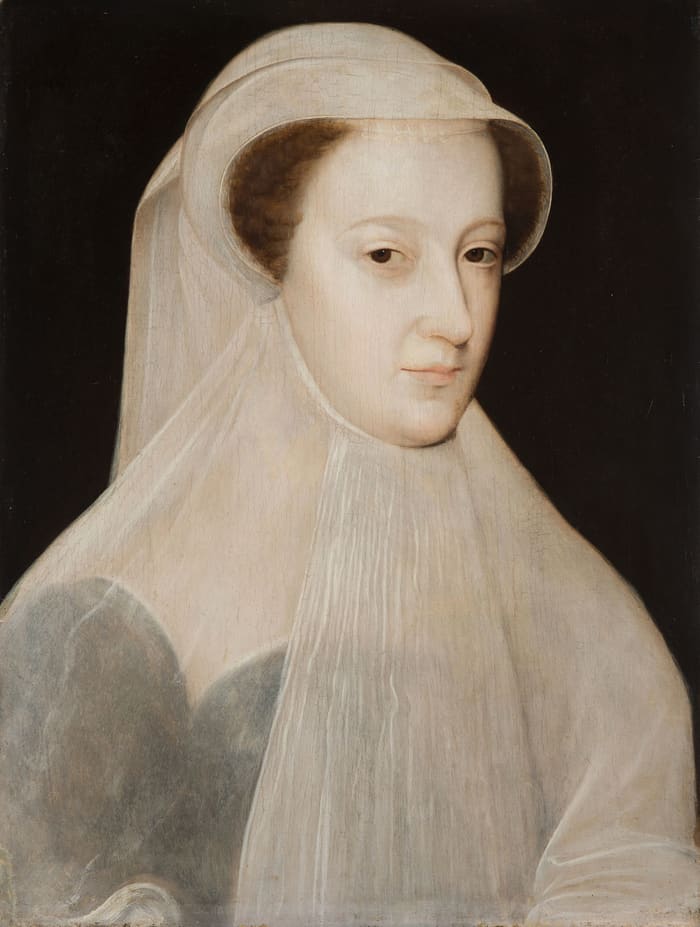
Mary, Queen of Scots in "white mourning", after François Clouet, c. 1560. This is her widow's white, painted after her husband died, not her wedding dress. Royal Collection, via Wikimedia Commons, public domain.

As the FIT puts it: "The idea of a white wedding dress was not novel in 1840."
10 February 1840: Victoria marries Albert
Royal brides were expected to marry in heavy robes of state. Victoria wore white satin, with a wreath of orange blossom where a crown or tiara might have been. Historians at the V&A think she chose to marry as Albert's wife rather than as the monarch.
Her own journal describes it like this: "I wore a white satin dress, with a deep flounce of Honiton lace, an imitation of an old design."
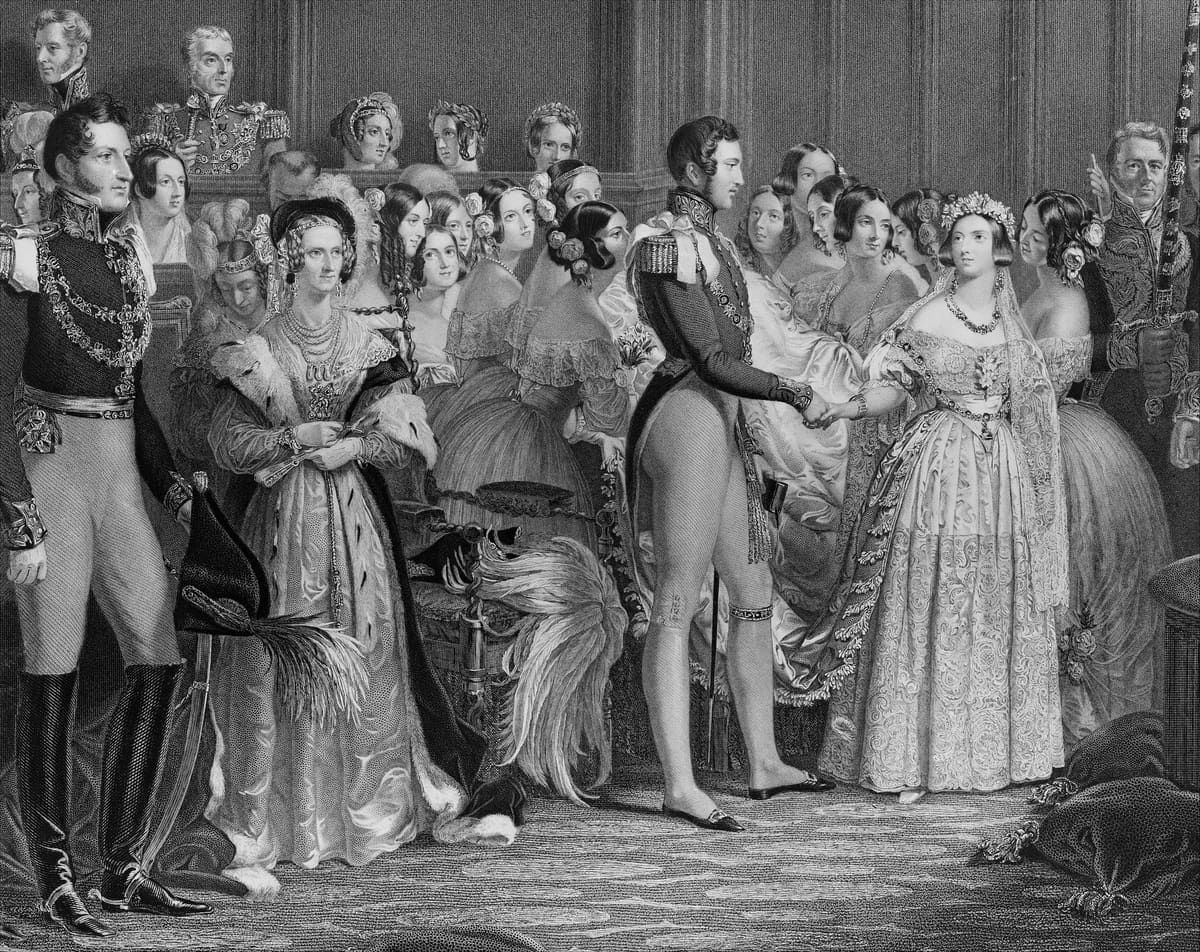
The Marriage of Queen Victoria, engraving by Charles Eden Wagstaff after Sir George Hayter's painting, 1844. The Metropolitan Museum of Art, CC0.
The lace came from Devon
The fashionable lace at the time came from Brussels. Victoria ordered hers from Honiton lacemakers in and around Beer, in Devon, a trade that was struggling, and the dress was made from British materials, with silk woven at Spitalfields in London. A newspaper report from 1839 says "more than 200 persons were employed upon it", and the FIT also puts it at around two hundred lacemakers.
The Royal Collection says she reused the lace and its design for decades, on her own clothes and her children's.
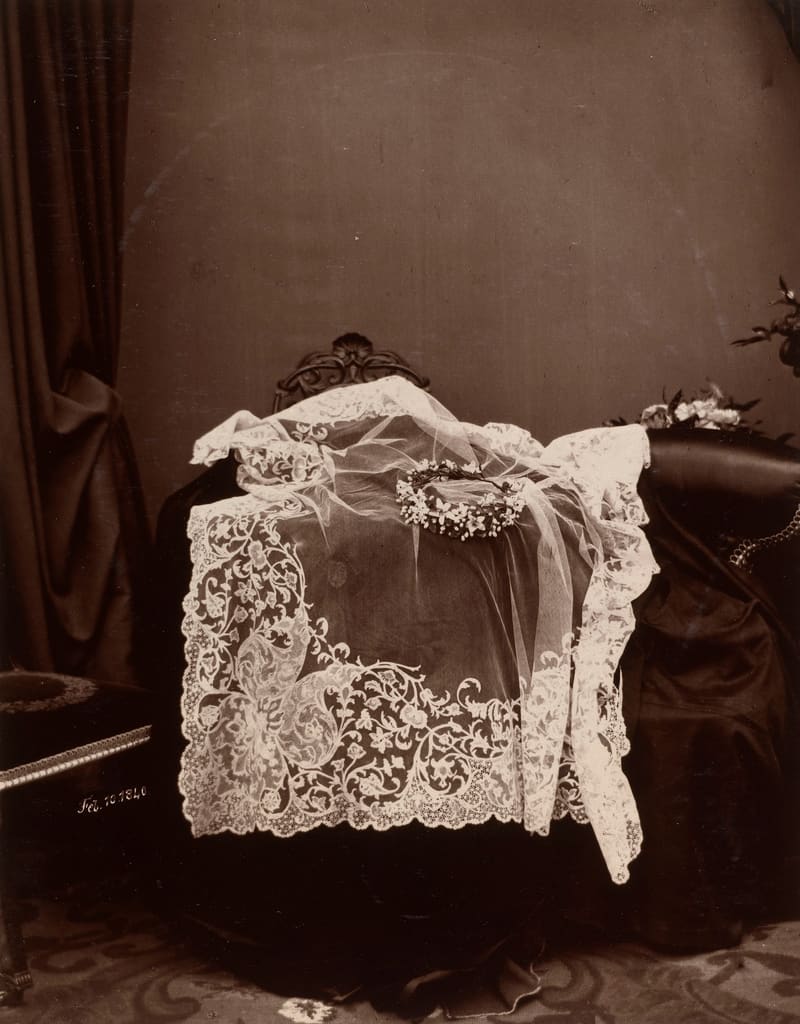
Victoria's Honiton lace wedding veil and orange blossom wreath, photographed around 1889 to 1891. Royal Collection, via Wikimedia Commons, public domain.

How it spread: prints, everywhere
Within months, several different publishers were selling their own prints of the ceremony: lithographs, a zincograph, even a sheet music cover for "The Bridal Waltzes" with the couple at the altar. Hayter's official painting was copied and reproduced for years.
And brides who could afford it copied her. You can see the look in what survives: the Metropolitan Museum has a wedding dress from around 1844, probably French, four years after Victoria's, in cream silk with the same off-the-shoulder bodice and full skirt.
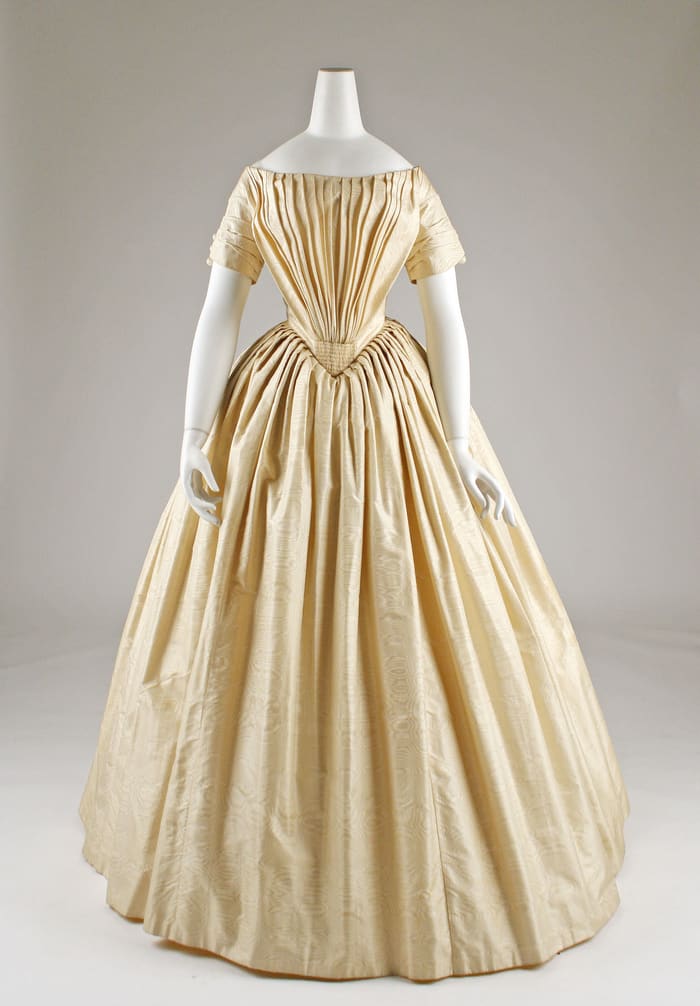
Wedding dress, c. 1844, probably French. The Metropolitan Museum of Art, CC0.
By 1849 an American magazine, Godey's Lady's Book, was telling readers that "custom has decided, from the earliest ages, that white is the most fitting hue". The earliest ages, in this case, being about nine years. (That line is quoted by the FIT; we have not seen the original issue ourselves.)
What we're not claiming
- That Victoria was the first. She popularised white; she did not invent it. The V&A's careful version is that she was the first in British history to dress in it entirely.
- That Mary, Queen of Scots definitely married in white. It is reported, and other accounts disagree. The portrait above shows her mourning white, not her wedding.
- That everyone copied her overnight. Coloured wedding dresses stayed common for years after 1840. White became the norm for a first wedding "if the bride could afford it", in the V&A's words.
- That her dress was brilliant white. The Royal Collection catalogues it as cream silk satin. Her own journal says white. Expect someone at your reception to say ivory.
- The numbers on the lace. "More than 200" workers, the destroyed designs and a reported £1,000 price all come from one newspaper account (the FIT backs up the rough number of lacemakers).
- That red was the popular colour before. You will read this online. We could not find a museum source that says so.
A note from us
We built Quiz Your Guests for our own wedding, and facts like these make good questions between the rounds about the couple. You can write your own multiple choice questions, one right answer and three wrong ones; guests scan a QR code, answer on their phones in two teams, and the scoring happens by itself. There is a printable wedding quiz too, if paper suits your day better.
More wedding myths
- Where does the word honeymoon come from?
- Where does "Here Comes the Bride" come from?
- Why does the groom carry the bride over the threshold?
- Why did eloping couples race to Gretna Green?
- Where does "a month's salary on the ring" come from?
Sources
- Fashion Institute of Technology, About the Look and 1840: Queen Victoria's Wedding Dress (includes the Godey's 1849 quote)
- V&A blog, Queen Victoria and the White Wedding Dress
- Marlise Schoeny, Ohio State Historic Costume and Textiles Collection, writing in The Conversation (2020), on brides' "best dress" before Victoria
- Royal Collection Trust, catalogue entry RCIN 71975 (the lace and its reuse), drawing on Kay Staniland, In Royal Fashion
- TRC Leiden, Queen Victoria's Wedding Lace (reproduces the 1839 newspaper report)
- Wikipedia, Wedding dress of Queen Victoria (quotes Victoria's journal for 10 February 1840)
- Tudor Society and History of Royal Women, on Mary, Queen of Scots' wedding (via Agnes Strickland)
Skip the spreadsheet
Everything in this guide — timed rounds, team scoring, escalating points — is built into Quiz Your Guests. Answer four questions and your quiz arrives already written and scheduled around your day.
Ready to run yours?
Your quiz arrives written, themed and timed around your day — free to try, no signup needed.
Create your wedding quiz →Keep reading