
Why Did Eloping Couples Race to Gretna Green?

In this guide
Eloping English couples raced to Gretna Green because it was the first easy stop over the Scottish border, and Scottish law let a couple marry simply by declaring it in front of two witnesses. No banns, no licence, no parents' consent, no church. The famous blacksmiths had no special power at all; they just provided the witnesses and charged a fee.
This is the long version of our "Wedding myths" video, with the law, the road and the anvil.
1754: England changes the rules
Lord Hardwicke's Marriage Act was passed in 1753 and came into force in March 1754. In England and Wales it let parents stop the marriage of anyone under 21, and it required every wedding to have banns or a licence. Secret, quick marriages became very hard to arrange.
The Act did not apply in Scotland.
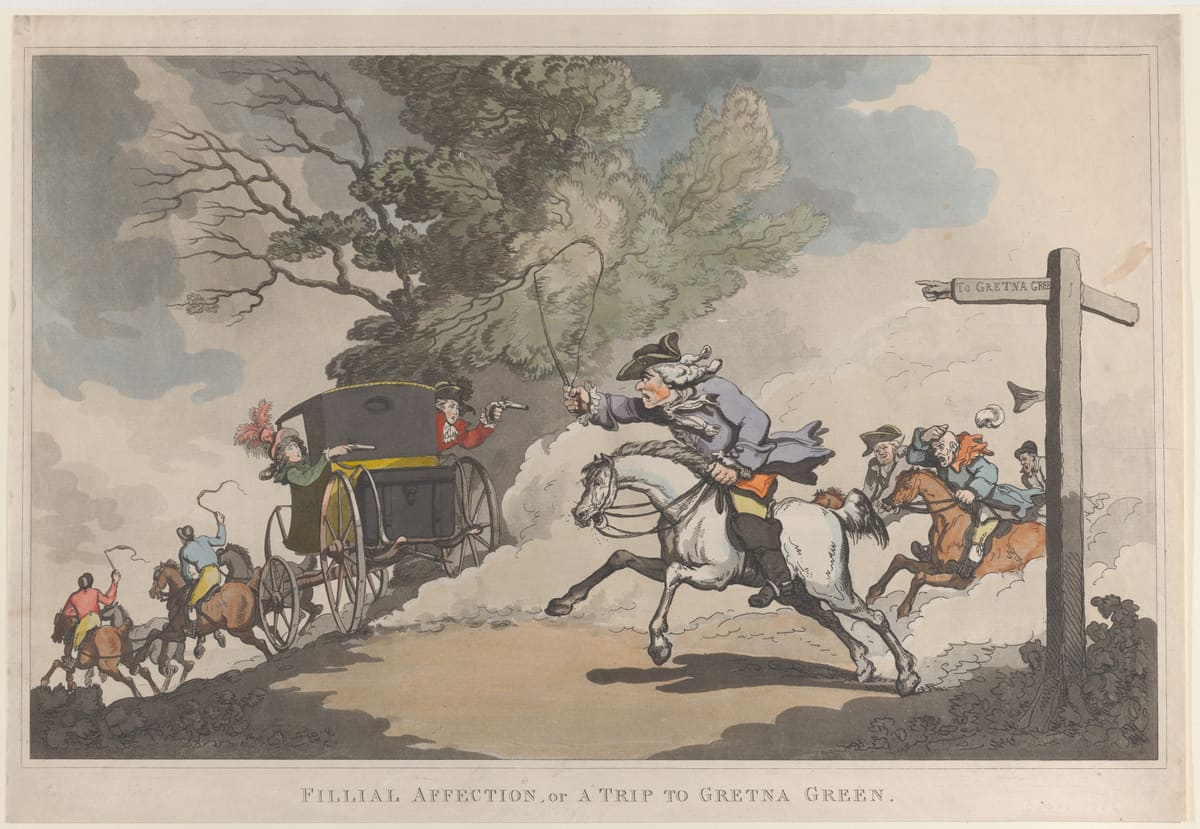
Filial Affection, or a Trip to Gretna Green, Thomas Rowlandson, 1785: the couple in the carriage, the father in pursuit. The Metropolitan Museum of Art, CC0.

What Scottish law actually needed
Scotland allowed what were called irregular marriages. If a couple declared they were married in front of two witnesses, they were married. As Wikipedia's summary of the legal history puts it, "almost anybody had the authority to conduct the marriage ceremony".
Irregular marriages were valid, but that does not mean they were approved of. The Church of Scotland could discipline the people involved. They were simply legal.
Why Gretna, of all places?
Not because of any special local law. Any village over the border would have done. What Gretna had was the road. Drawing on the legal historian Rebecca Probert, Wikipedia puts it like this: it was "only in the 1770s, with the construction of a toll road passing through the hitherto obscure village of Graitney, that Gretna Green became the first easily reachable village over the Scottish border." When somebody may be chasing you, the first village is the one that counts.
It was not the only one. Coldstream Bridge, Lamberton, Mordington, Paxton Toll and Portpatrick all did a trade in runaway marriages too. Gretna just got the name.
By 1813 it was famous enough to be a plot point. In Pride and Prejudice, Lydia Bennet leaves a note saying "I am going to Gretna Green, and if you cannot guess with who, I shall think you a simpleton". (Spoiler: she never gets there.)
And the blacksmiths?
The men who ran the ceremonies at Gretna became known as "anvil priests". They were self-appointed local men who charged a fee and supplied the witnesses. The anvil became the symbol, and the symbol stuck. According to Olga Sinclair's history of Gretna Green, one of the last of them, Richard Rennison, performed 5,147 ceremonies.
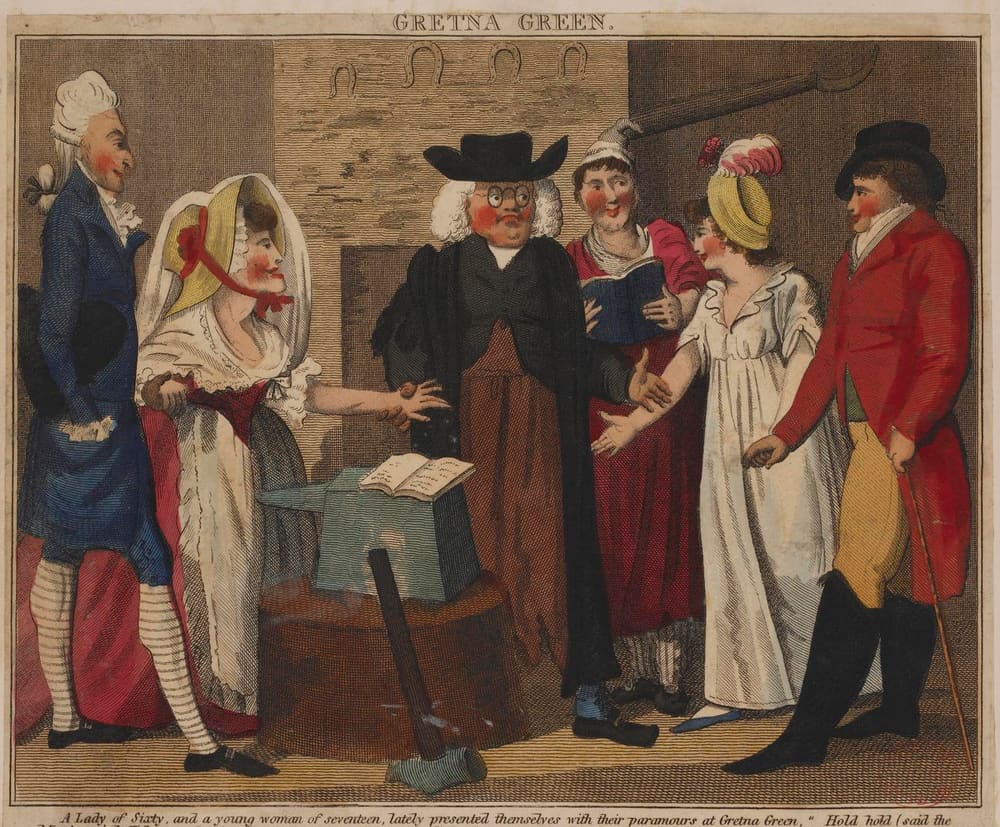
Gretna Green, an anonymous satirical print from between 1795 and 1805, with the "priest", his anvil and hammer. British Museum, via Wikimedia Commons, public domain.
.jpg)
So the blacksmith never had any more right to marry you than the innkeeper did. What you needed was two witnesses, and a fast horse.
How it ended
Scotland tightened the rules in stages. An act of 1856, Lord Brougham's Act, added a residence requirement of 21 days in Scotland before an irregular marriage, which made a quick dash over the border much harder. Marriage by declaration itself was abolished by the Marriage (Scotland) Act 1939, which came into force in 1940.
Gretna Green is still a wedding venue today, with anvil ceremonies that are perfectly ordinary legal weddings. The romance outlived the loophole.
What we're not claiming
- That anyone could legally marry you in Scotland. The couple's declaration made the marriage. The "priest" was a facilitator, which is why we say what the law required rather than who could perform it.
- That the most famous priest wasn't a blacksmith. Some sources say Joseph Paisley was a smuggler and tobacconist before he took up the anvil; others disagree. We left him out.
- That 5,147 is exact. It comes from one history of the village.
- The finer points of 1856. Sources differ on whether one or both of the couple had to live in Scotland for those 21 days.
- That there is anything wrong with getting married at Gretna Green today. The joke is on 18th century law, not on the village.
A note from us
We built Quiz Your Guests for our own wedding, and facts like these make good questions between the rounds about the couple. You can write your own multiple choice questions, one right answer and three wrong ones; guests scan a QR code, answer on their phones in two teams, and the scoring happens by itself. There is a printable wedding quiz too, if paper suits your day better.
More wedding myths
- Who started the white wedding dress?
- Where does the word honeymoon come from?
- Where does "Here Comes the Bride" come from?
- Why does the groom carry the bride over the threshold?
- Where does "a month's salary on the ring" come from?
Sources
- Rebecca Probert, Marriage Law and Practice in the Long Eighteenth Century (Cambridge University Press, 2009), chapter 7
- Olga Sinclair, Gretna Green: A Romantic History (1989)
- Wikipedia, Gretna Green (citing Probert and Sinclair) and Marriage Act 1753
- Jane Austen, Pride and Prejudice (1813), chapters 46 and 47, Project Gutenberg
Skip the spreadsheet
Everything in this guide — timed rounds, team scoring, escalating points — is built into Quiz Your Guests. Answer four questions and your quiz arrives already written and scheduled around your day.
Ready to run yours?
Your quiz arrives written, themed and timed around your day — free to try, no signup needed.
Create your wedding quiz →Keep reading