
Where Does the Word Honeymoon Come From?

In this guide
The word honeymoon does not come from a month of drinking honey mead. The earliest record of it, from 1546, is a joke about how quickly newlyweds stop being sweet on each other: honey now, then it changes like the moon.
This is the long version of our "Wedding myths" video about it, with the old books themselves, because for once the evidence fits on a page.
1546: a young couple, fifteen weeks later
The first time the word turns up in writing (the earliest the Oxford English Dictionary has found) is in a book of proverbs by John Heywood, a Tudor writer best known for plays and epigrams. In a long rhyming story, he describes "this young poore couple" who could not look at each other without smiling, and then adds:
Abyde, (quoth I), it was yet but hony moone ;
A few lines later the shine is gone:
The flowers so faded that in fifteene weekes,
A man might espye the change in their cheekes.
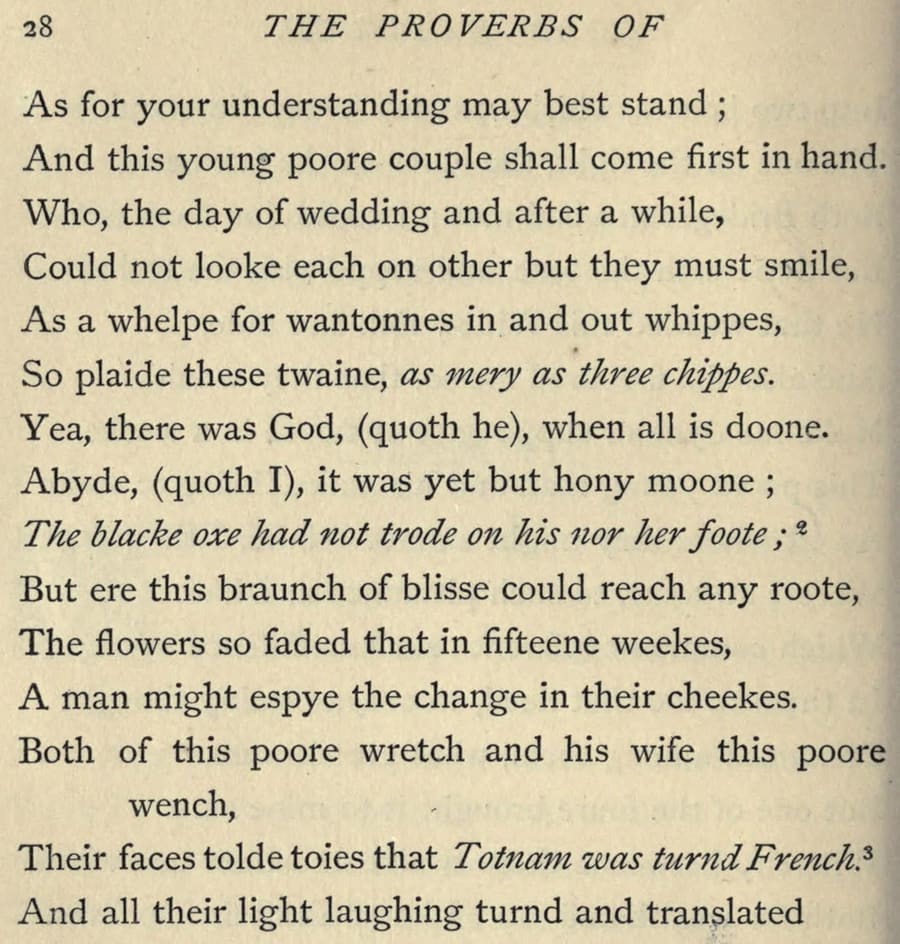
John Heywood's Proverbs (first printed 1546), page 28 of the 1874 reprint published by George Bell and Sons. The spellings are the reprint's. Internet Archive, public domain.
So the very first honeymoon on record is not romantic at all. It is a wry little warning: enjoy it, it won't last. Whether Heywood made the word up or was repeating a saying that already existed, nobody knows. Six years later, in 1552, Richard Huloet's dictionary already describes it as a proverbial term for the newly married.
1656: a dictionary spells out the joke
A century later Thomas Blount put it in his Glossographia, a dictionary of hard words, and explained exactly what the moon was doing there:
Hony=moon, applied to those marryed persons that love well at first, and decline in affection afterwards; it is hony now, but it will change as the Moon.
That is the whole etymology in one line: the moon is a picture of something that waxes and then wanes.
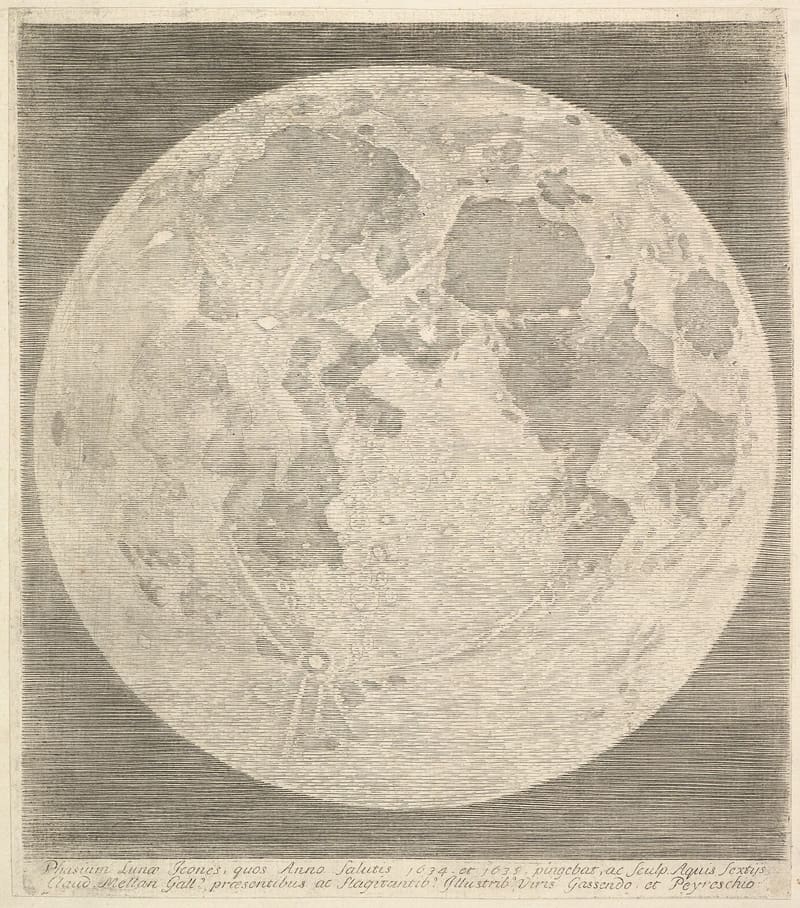
The full moon, engraved by Claude Mellan in 1635, about twenty years before Blount's dictionary. The Metropolitan Museum of Art, CC0.

To be fair to the word, it softened. By 1755 Samuel Johnson's dictionary defines it, as quoted by Word Histories and the OUP blog, as "the first month after marriage, when there is nothing but tenderness and pleasure". So it has not always meant decline. It just started there.
When the honeymoon became a trip
The honeymoon as a journey is a much newer idea. Around 1800, well-off British couples began taking a "bridal tour" after the wedding, often to visit relatives who had not been able to come. The word honeymoon was only attached to the trip around then too.
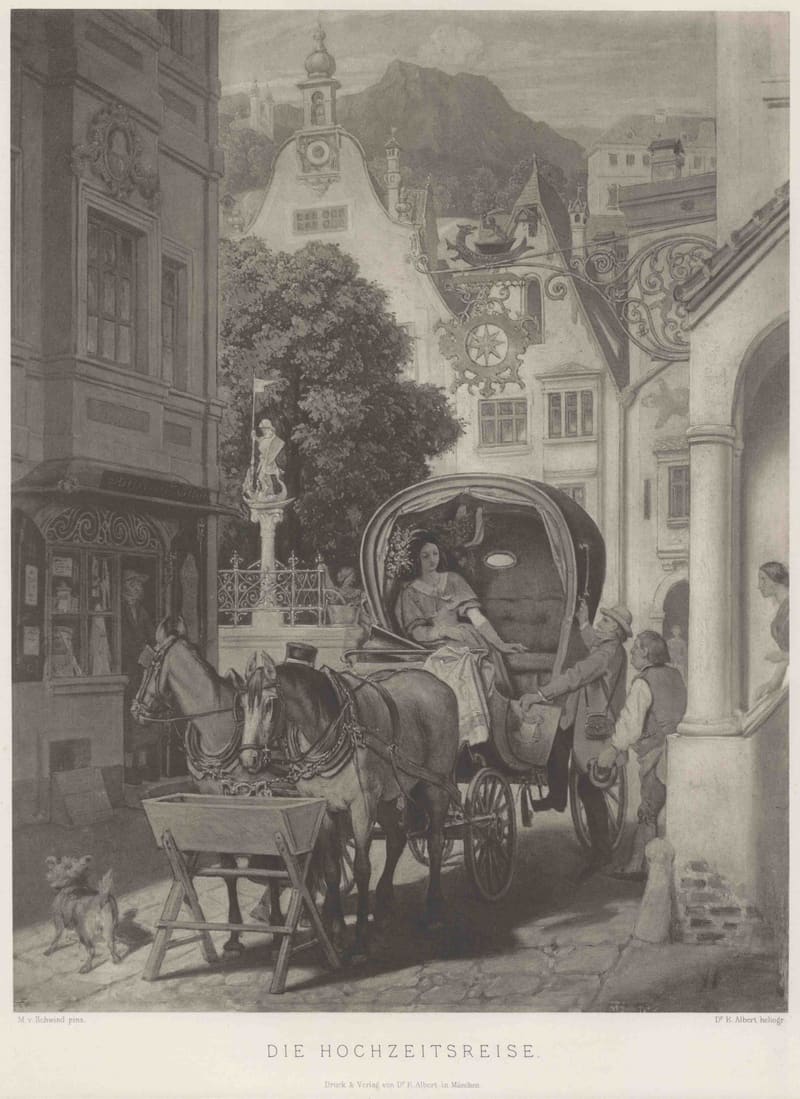
Die Hochzeitsreise (The Wedding Journey), Moritz von Schwind, painted around 1850 to 1852, from an 1890 Munich print. Via Wikimedia Commons, public domain.

And the mead?
The story you will hear most often is that newlyweds drank mead, a drink made from honey, for a month after the wedding, and that is where the name comes from. The earliest version we could find in print is in William Pulleyn's Etymological Compendium, in the second edition of 1830:
It was the custom of the higher order of the Teutones, an ancient people who inhabited the northern parts of Germany, to drink Mead, or Metheglin, a beverage made with honey, for thirty days after every wedding. From this custom, comes the expression, "to spend the Honey-moon."
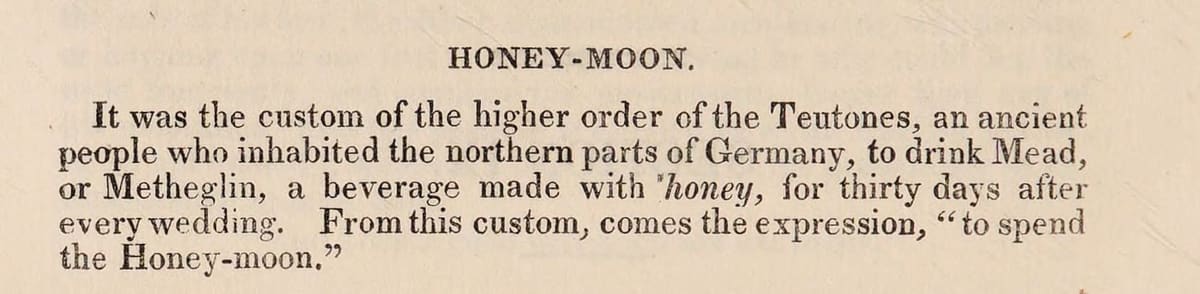
William Pulleyn, The Etymological Compendium, second edition (London: Thomas Tegg, 1830), page 142. Wellcome Collection copy via the Internet Archive, Public Domain Mark.
That is nearly three hundred years after Heywood. It gives no source, and the word had been explained by the moon's phases for well over a century before the mead story turns up in print. Later reference books such as Brewer's Dictionary of Phrase and Fable repeated it, and it has been repeated ever since.
What we're not claiming
- That Heywood invented the word. His is the earliest record found so far, not proof that he coined it.
- That 1830 is the first time anyone told the mead story. It is the earliest printing we found. There may be earlier ones.
- That nobody drank mead at weddings. Plenty of people did. The myth is only that mead gave the honeymoon its name.
- An exact year for the trip. "Around 1800" is as precise as our sources allow.
- That honeymoon always meant love fading. Johnson's 1755 definition is perfectly kind. We only say that the first one on record was a joke about it going off.
- Norse or Babylonian origins. You will find these online. We found no evidence for them; that is all we can say.
A note from us
We built Quiz Your Guests for our own wedding, and facts like these make good questions between the rounds about the couple. You can write your own multiple choice questions, one right answer and three wrong ones; guests scan a QR code, answer on their phones in two teams, and the scoring happens by itself. There is a printable wedding quiz too, if paper suits your day better.
More wedding myths
- Who started the white wedding dress?
- Where does "Here Comes the Bride" come from?
- Why does the groom carry the bride over the threshold?
- Why did eloping couples race to Gretna Green?
- Where does "a month's salary on the ring" come from?
Sources
- John Heywood, Proverbs (1546), 1874 reprint, p. 28, Internet Archive
- Thomas Blount, Glossographia (1656), entry "Hony=moon", Internet Archive
- William Pulleyn, The Etymological Compendium, 2nd edition (1830), p. 142, Internet Archive
- Samuel Johnson, A Dictionary of the English Language (1755), Internet Archive
- Anatoly Liberman, Honeymoon, OUP blog, 2008
- Word Histories, Honeymoon
- Wikipedia, Honeymoon (for the bridal tour and Huloet, 1552)
Skip the spreadsheet
Everything in this guide — timed rounds, team scoring, escalating points — is built into Quiz Your Guests. Answer four questions and your quiz arrives already written and scheduled around your day.
Ready to run yours?
Your quiz arrives written, themed and timed around your day — free to try, no signup needed.
Create your wedding quiz →Keep reading