
Where Does "Can't Help Falling in Love" Really Come From?

In this guide
The tune of "Can't Help Falling in Love" is borrowed from "Plaisir d'amour", an old French love song with music by Jean-Paul-Égide Martini and words first printed in 1784, in a story by Jean-Pierre Claris de Florian. In that story the words are sung by a young goatherd on the day his sweetheart marries his rival. So one of Britain's favourite first dances borrows its tune from a song written for the man who lost the bride.
This is the long version of our "Wedding myths" video, with the 1961 paperwork, the 1784 page and a goatherd under a willow.
A first dance with a long memory
In Encore Musicians' figures for 2023, drawn from more than 3,000 events and reported by NME, it was the third most-played first dance at UK weddings, after "Perfect" and "All of Me". Not the favourite, then, but firmly one of them.
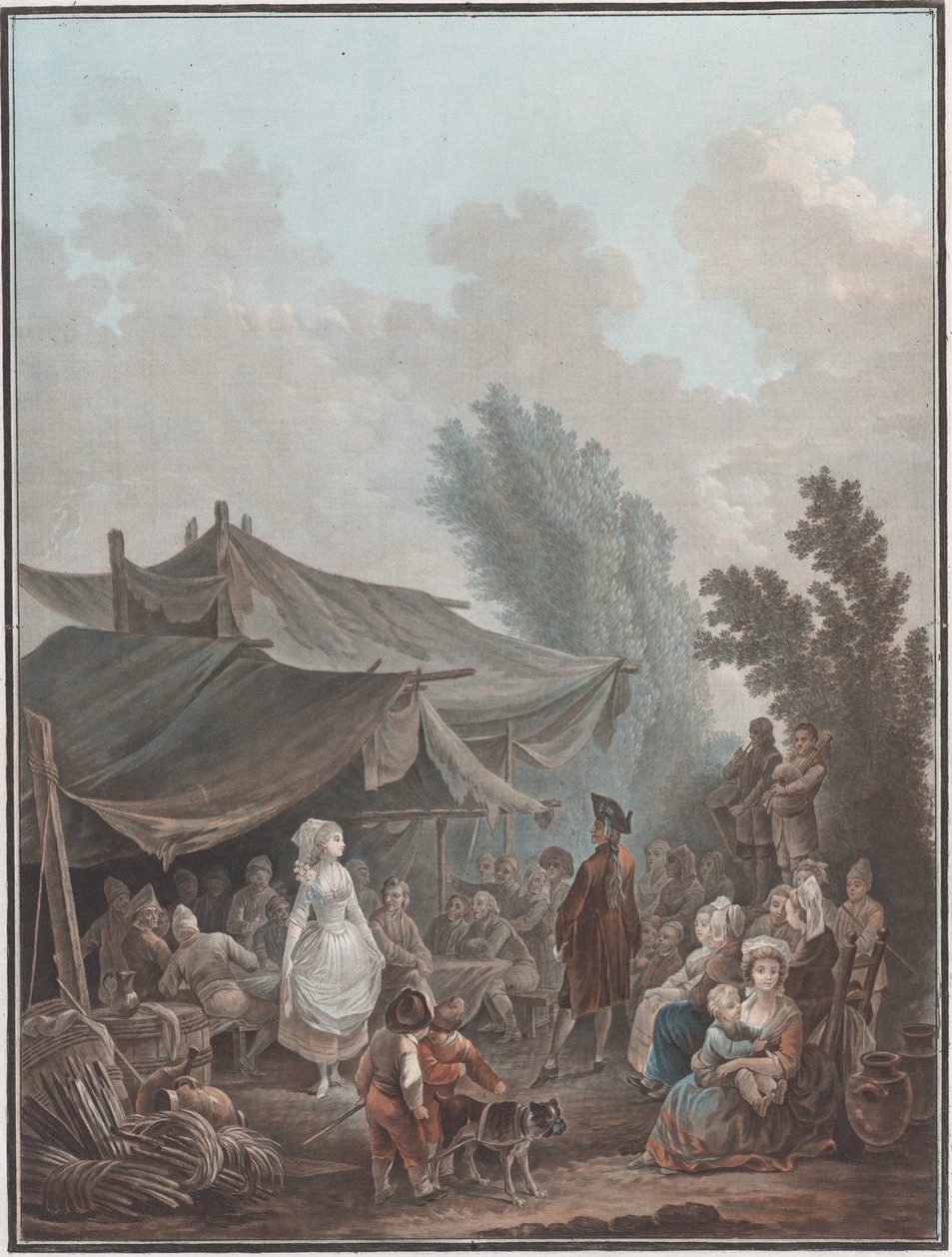
La Noce de Village, a colour aquatint by Charles-Melchior Descourtis after Nicolas-Antoine Taunay, between 1788 and 1794: a French village wedding from the years of the song. The Metropolitan Museum of Art, CC0.
1961: the film and the paperwork
Elvis recorded "Can't Help Falling in Love" on 23 March 1961, and it comes from his film Blue Hawaii, set in Hawaii. So if Hawaii is what comes to mind, that is the setting, not the song.
The US Copyright Office had already registered it, on 16 January 1961, as "w & m" (words and music) by George Weiss, Hugo Peretti and Luigi Creatore. The published version followed in December:
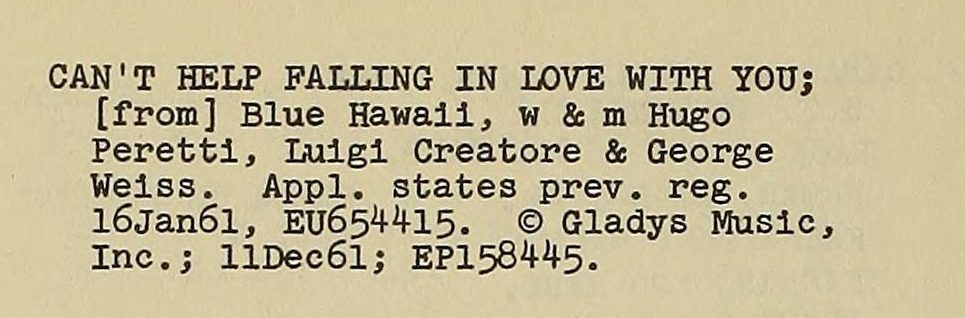
Catalog of Copyright Entries, third series, Music, July to December 1961, p. 1124, the entry for 11 December 1961. US Copyright Office, via the Internet Archive, public domain.
Three songwriters, and no Martini anywhere. That is perfectly normal: building a new song on a public domain tune is legal and common. The words are theirs. The tune is nearly 180 years older.
"Plaisir d'amour"
"Plaisir d'amour" means "the pleasure of love". The music library IMSLP dates Martini's music to about 1784; it was first published in Paris in 1785, in a songbook called Etrennes de Polymnie, for voice and guitar.
Before anyone writes in: yes, Martini was German. He was born in Bavaria and known as "Il Tedesco", the German. But the words are French and the song was first published in France, so an old French love song is a fair description.
The link to 1961 is no internet rumour. The Guinness Book of 500 Number One Hits (1982) calls the song "based on the old French tune, 'Plaisir d'Amour'", and W. W. Norton's textbook The Musician's Guide to Fundamentals prints the opening eight bars of "Plaisir d'amour" for students to compare with it.
The goatherd who lost the bride
The words came first. Florian's "Célestine", a "nouvelle espagnole" set in Spain, was printed in his Les Six Nouvelles (Paris, 1784). Célestine has been abandoned and is hiding in a grotto by a spring when she hears a country flute, and then a voice singing "sur un air rustique", to a rustic air:
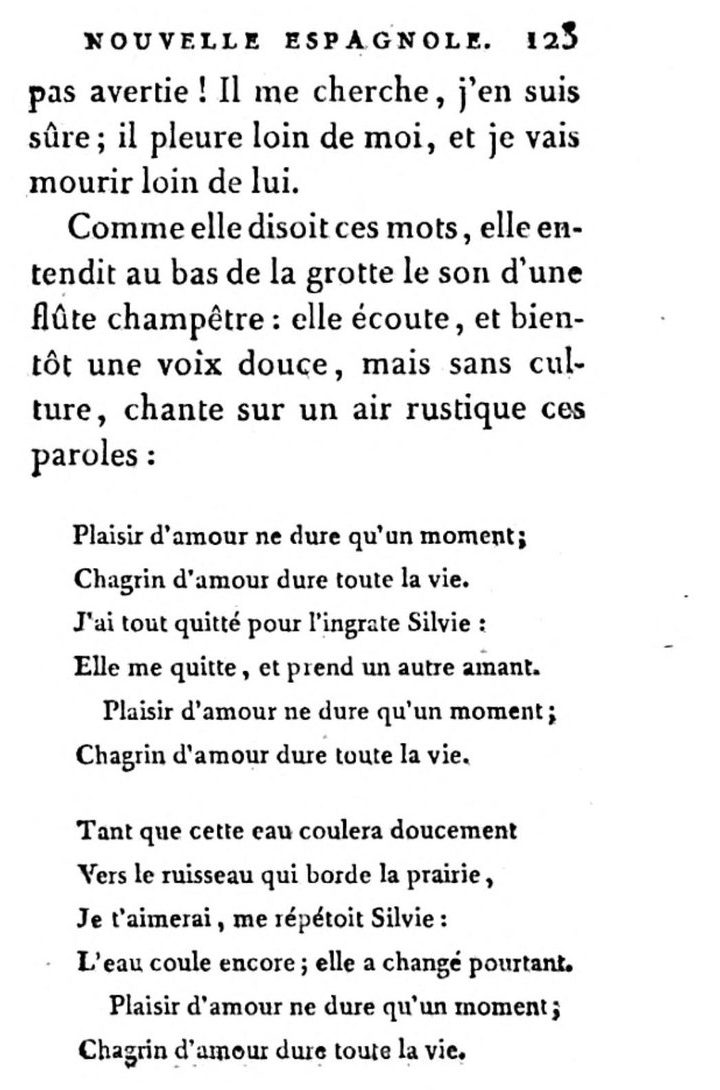
"Plaisir d'amour" as first printed: Florian, Les Six Nouvelles (Paris, Didot l'aîné, 1784), "Célestine", p. 123. National Library of Naples copy, Google scan, via the Internet Archive, public domain.
Plaisir d'amour ne dure qu'un moment ;
Chagrin d'amour dure toute la vie.
J'ai tout quitté pour l'ingrate Silvie :
Elle me quitte, et prend un autre amant.
Plaisir d'amour ne dure qu'un moment ;
Chagrin d'amour dure toute la vie.Tant que cette eau coulera doucement
Vers le ruisseau qui borde la prairie,
Je t'aimerai, me répétoit Silvie :
L'eau coule encore ; elle a changé pourtant.
Plaisir d'amour ne dure qu'un moment ;
Chagrin d'amour dure toute la vie.
In our own English: "The pleasure of love lasts only a moment; the sorrow of love lasts all your life. I gave up everything for faithless Silvie; she is leaving me, and taking another lover." And: "'As long as this water flows gently to the brook along the meadow, I will love you,' Silvie kept telling me. The water still flows. But she has changed."
"Who knows that better than I!" cries Célestine. It was a young goatherd, sitting under a willow, watching the water with tear-filled eyes. He cannot go back to the village, he tells her, because "ma maîtresse doit épouser aujourd'hui même mon rival": his sweetheart is marrying his rival that very day.
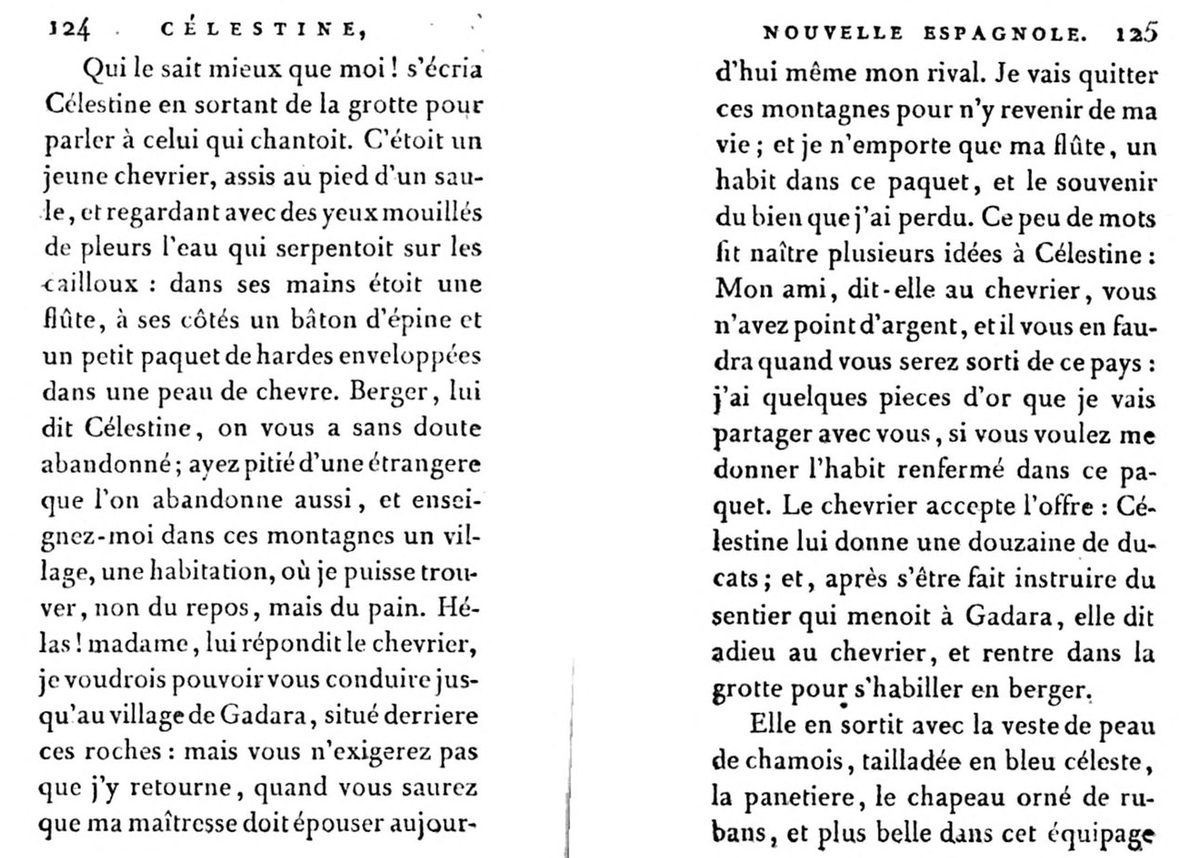
The goatherd's story: Florian, Les Six Nouvelles (1784), pp. 124 and 125, from "Qui le sait mieux que moi !" to "d'hui même mon rival". National Library of Naples copy, Google scan, via the Internet Archive, public domain.
So the first "Plaisir d'amour" is a wedding day song, sung by the one man with nothing to celebrate that day.
Can you use it at your wedding?
Of course. The 1961 song is a sincere love song in its own right. And if you like the history, "Plaisir d'amour" itself is long out of copyright and would make a gentle walk-in or signing tune, as long as nobody translates the words for the guests.
It makes a good quiz question too: "Which old French song gave 'Can't Help Falling in Love' its tune?" Our wedding pub quiz guide has a question about the film, and the story behind "Here Comes the Bride" has a twist of its own.
What we're not claiming
- That it is the UK's favourite first dance. It was No. 3 in Encore Musicians' 2023 figures, which is why we say "one of".
- That the two tunes match note for note. The sources say "based on", and so do we. We make no claim either way about the middle section of the 1961 song.
- That anyone stole anything. Borrowing a public domain melody is legal and normal.
- Whether the song was written for the film. It is from Blue Hawaii; the records we read say no more than that.
- What happens in the film. Several Elvis books describe the scene; we haven't watched it, so we left it out.
- That Martini wrote the goatherd's tune. In the story he sings to "un air rustique"; Martini's setting came later.
A note from us
We built Quiz Your Guests for our own wedding, and facts like these make good questions between the rounds about the couple. You can write your own multiple choice questions, one right answer and three wrong ones; guests scan a QR code, answer on their phones in two teams, and the scoring happens by itself. There is a printable wedding quiz too, if paper suits your day better.
More wedding myths
- Who started the white wedding dress?
- Where does the word honeymoon come from?
- Where does "Here Comes the Bride" come from?
- Why does the groom carry the bride over the threshold?
- Why did eloping couples race to Gretna Green?
- Where does "a month's salary on the ring" come from?
- Why were June brides said to be better off than May ones?
- Who came up with women proposing in a leap year?
- Where does the seven-year itch come from?
- Why did so many couples marry in March?
- Why was the 1923 royal wedding not on the radio?
Sources
- Jean-Pierre Claris de Florian, Les Six Nouvelles (Paris, Didot l'aîné, 1784), "Célestine, nouvelle espagnole", pp. 123 to 125, Internet Archive
- US Copyright Office, Catalog of Copyright Entries, third series, vol. 15, part 5, Music, January to June 1961 and July to December 1961, p. 1124
- IMSLP, Plaisir d'amour (Martini, Jean Paul Egide)
- Jo Rice, The Guinness Book of 500 Number One Hits (1982)
- The Musician's Guide to Fundamentals, 3rd edition (W. W. Norton)
- Robert Matthew-Walker, Elvis Presley: A Study in Music (1979), for "Il Tedesco"
- Essential Elvis (1997), for the recording date
- Tom Skinner, "The most-played wedding song of 2023 revealed", NME, 20 December 2023
- Wikipedia, Can't Help Falling in Love and Plaisir d'amour
Skip the spreadsheet
Everything in this guide — timed rounds, team scoring, escalating points — is built into Quiz Your Guests. Answer four questions and your quiz arrives already written and scheduled around your day.
Ready to run yours?
Your quiz arrives written, themed and timed around your day — free to try, no signup needed.
Create your wedding quiz →Keep reading