
Why Was the 1923 Royal Wedding Not on the Radio?

In this guide
The 1923 royal wedding was kept off the radio because Westminster Abbey said no. The brand-new BBC asked to broadcast the service, and the reason on record had nothing to do with the equipment: the Abbey worried the service would be heard by "a considerable number of persons in an irreverent manner", and that it "might even be received by persons in Public Houses with their hats on". In other words, the pub.
This is the long version of our "Wedding myths" video, with who actually said no, what the BBC could already do, and the wireless set the groom got as a present.
26 April 1923: a wedding and a very young BBC
On 26 April 1923, Prince Albert, the future King George VI, married Lady Elizabeth Bowes-Lyon at Westminster Abbey. According to BBC History, holding it at the Abbey rather than in a royal chapel was itself a break with tradition.
The BBC of 1923 was not the BBC we know. It was the British Broadcasting Company, incorporated on 15 December 1922 and licensed on 18 January 1923 (the Corporation came later, in 1927). So when it asked to broadcast the royal wedding service, it was only a few months old.
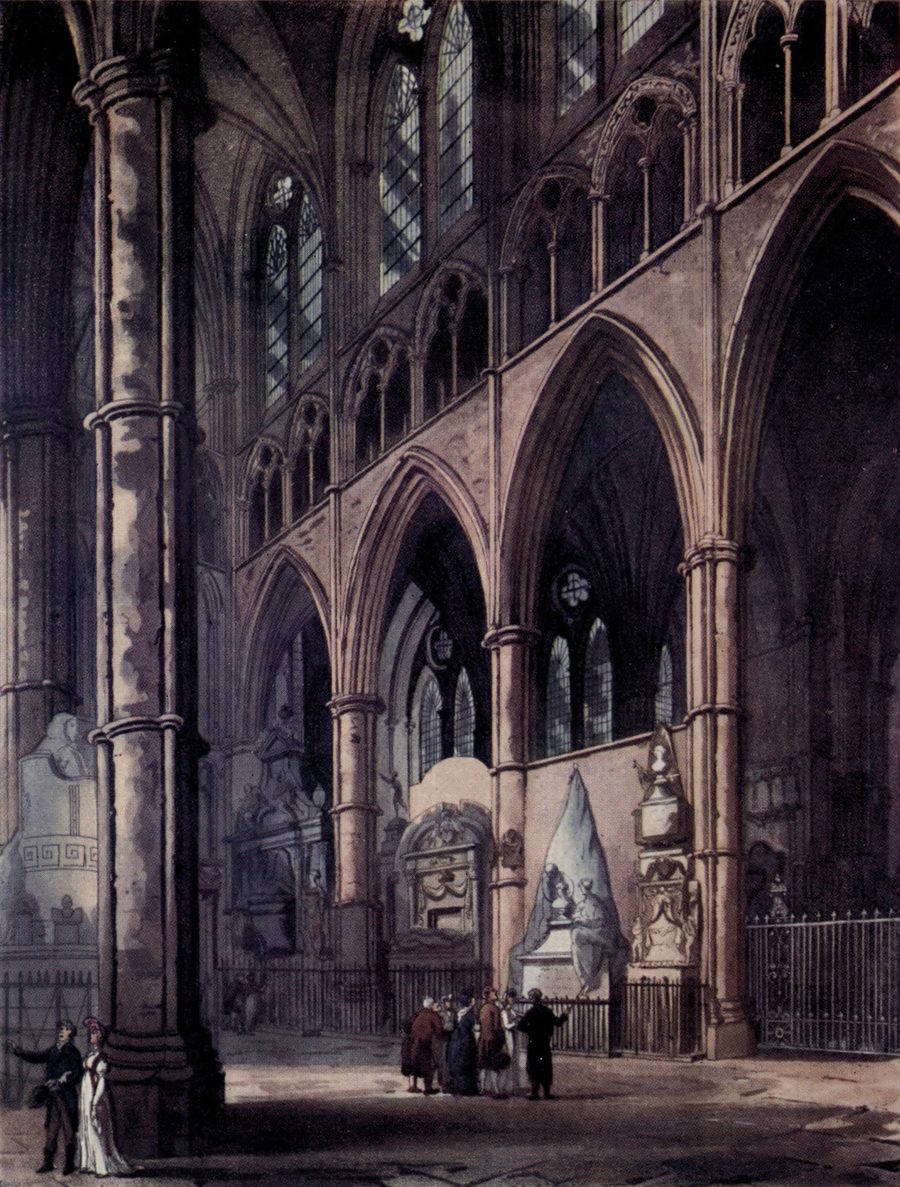
Westminster Abbey, plate 93 of The Microcosm of London, Thomas Rowlandson and Augustus Charles Pugin, published by Rudolph Ackermann, 1808 to 1810: the Abbey a century before the wedding. From the 1904 Methuen edition via Wikimedia Commons, public domain.

Who actually said no
The Abbey did. Westminster Abbey is run by its own Dean and Chapter, and that is where the refusal came from. The authorised life of Archbishop Randall Davidson, by Bell (1935), refers to "the refusal of the Dean of Westminster to allow the wedding of the Duke of York to be broadcast from the Abbey". Charles Smyth, who was a Canon of Westminster, wrote in 1959 that the Chapter objected. Helen Cathcart's biography of the Queen Mother says "The Abbey Chapter, however, solemnly vetoed the prospect", and the BBC's John Reith also names the Chapter (as Wikipedia reads his memoir).
You will often read that it was the Archbishop of Canterbury. BBC History says the service was not broadcast "because the Archbishop of Canterbury was concerned that men might listen to it in public houses." Bell and Smyth contradict that. Bell's book even shows Davidson welcoming Reith's broadcasting plans in March 1923. So we say "the Abbey", which is true whether you count the Dean or the Chapter.
Smyth also says "the Duke himself had given his permission", and Cathcart says he approved. Those two accounts may well come from the same original source, so treat it as likely rather than certain.
The reason, in the Abbey's words
Here is how Smyth gives the Chapter's objection: that the service would be heard by "a considerable number of persons in an irreverent manner, and might even be received by persons in Public Houses with their hats on."
So the pub was the worst case, not the whole worry. The bigger concern was how people might listen: casually, irreverently, anywhere at all. The same wording turns up in Cathcart, in Dinwiddie's Religion by Radio (1968), in the Royal Collection's Ring and Crown (2011) and in about 30 other books. Note that it says "persons", not "men".
Was it really not the technology?
That is the natural guess, and our film stamps it a myth. No source we found gives a technical reason. The BBC had already relayed The Magic Flute from Covent Garden in January 1923, its first outside opera broadcast, according to the historian Asa Briggs.
No church service had been broadcast yet; the first was from St Martin-in-the-Fields on 6 January 1924. So we cannot promise the equipment would have coped, only that nobody at the time gave it as the reason.
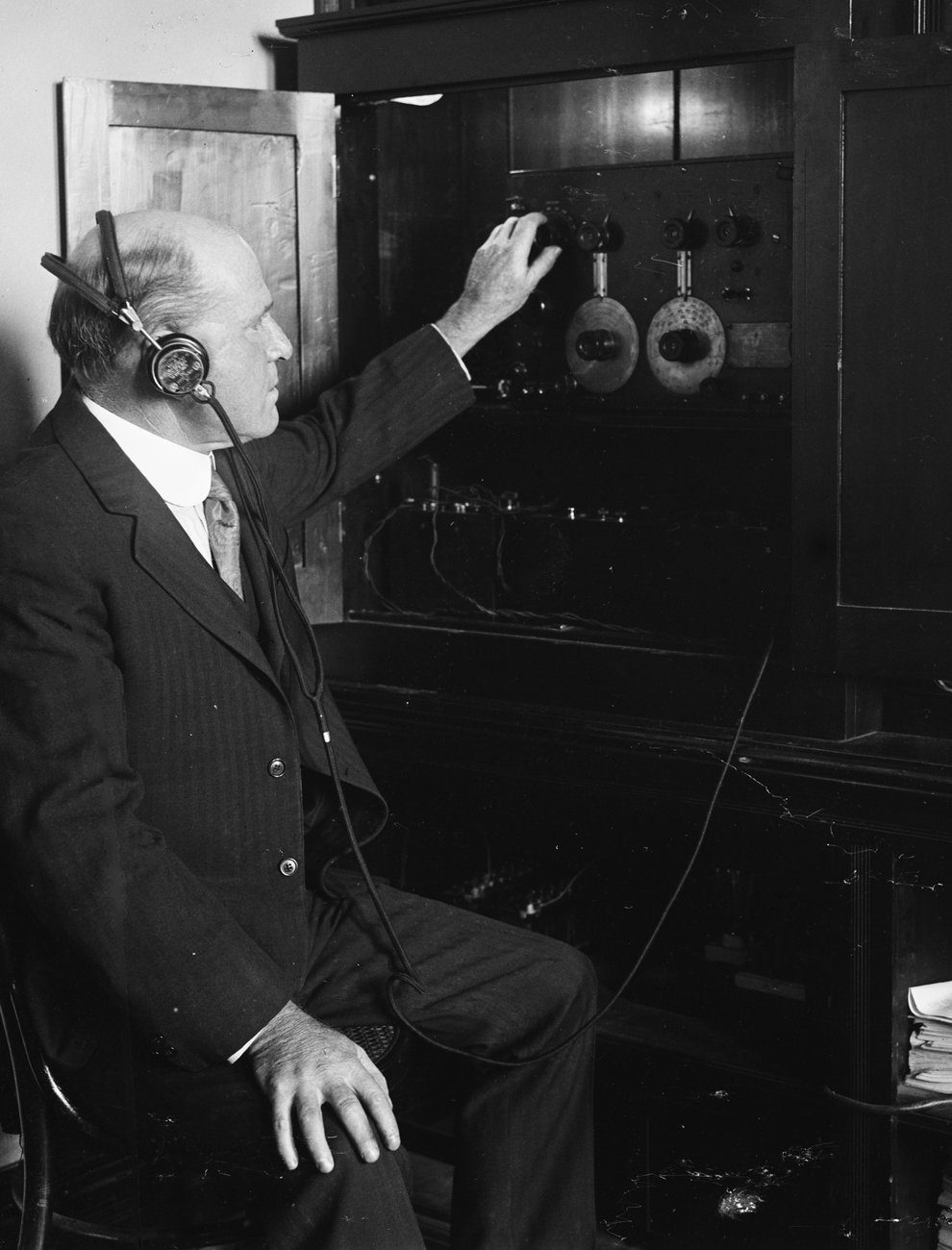
Man listening to radio, Harris & Ewing, 1923 (cropped): an American listener, but this is what tuning in looked like that year. Library of Congress via Wikimedia Commons, no known restrictions.

Did hardly anyone own a wireless?
This one is closer to true, which is why the film gives it "sort of" rather than "myth". Briggs records that "only 80,000 BBC licences had been taken out by 1 March 1923", and a second history of the BBC by Davies gives the same figure. Wireless really was new.
But a licence count is not a count of listeners. In March 1923 Reith told Archbishop Davidson there were "something like 100,000 listeners in London", which suggests plenty of people were listening without a licence. And the Abbey's own objection was that "a considerable number of persons" would hear it. Few licences, then, but it was not the reason anybody gave.
The groom's wedding present
On 25 April 1923, the day before the wedding, the Victoria Daily Times in British Columbia carried a report from London about the presents:
Gift of Wireless Set. One of the unique gifts received by the Duke is a powerful wireless receiving set built up on a mahogany tea table. It is the gift of a New York admirer.
That is all we know about it: one report in one Canadian paper, and the admirer is not named. A radio, for the man whose wedding couldn't be on one.
What changed
Eleven years later it was different. On 29 November 1934, the wedding of Prince George and Princess Marina, also at Westminster Abbey, was "the first royal wedding to be broadcast live by radio to the public", as the historian Edward Owens puts it. Ring and Crown agrees. People listened together: the Manchester Guardian, quoted by Owens, described listeners in Manchester's "shops and restaurants", where "The women seated at the tables ... listened attentively to the beautiful service".
Television took longer. Owens writes that "the BBC was prevented from televising the 1947 royal wedding ceremony out of concern for the privacy of the royal family". Which royal wedding the cameras finally got into is one of the questions in our celebrity wedding trivia, along with the 1923 bride's bouquet.
And the pubs?
In 2011, for another royal wedding, the Home Office made the Licensing Act 2003 (Royal Wedding Licensing Hours) Order 2011. It let pubs and clubs in England and Wales serve until 1am on the Friday and Saturday nights of the wedding weekend: in the Order's words, "the periods of 2 hours beginning at 11pm on each of 29th April 2011 and 30th April 2011." Sales to take away were not included. The Order calls the celebration period "an occasion of exceptional national significance".
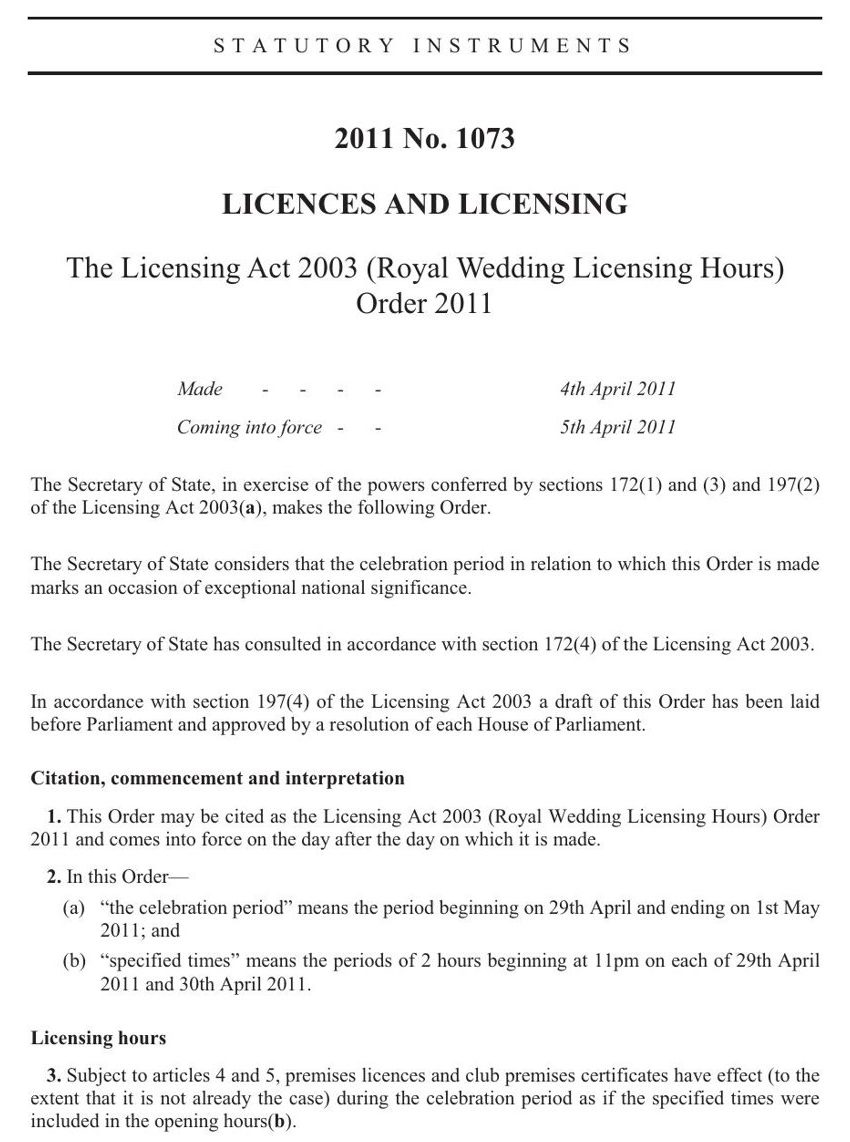
The Licensing Act 2003 (Royal Wedding Licensing Hours) Order 2011, SI 2011/1073, page 1 (detail), made 4 April 2011. legislation.gov.uk. Contains public sector information licensed under the Open Government Licence v3.0.
It was not a one-off: a similar Order in 2018 did the same for 18 and 19 May. In 1923 the Abbey didn't want the service heard in pubs; by 2011 Parliament was approving extra hours for them.
What we're not claiming
- That nobody heard anything about the wedding on the radio. The BBC may well have reported it in its news. What the Abbey kept off the air was the service itself.
- That the equipment would have coped. No source gives a technical reason for the refusal, but no church service had been broadcast before 1924 either.
- Exactly who signed the refusal. Bell names the Dean; Smyth, Cathcart and Reith name the Chapter. Either way it was the Abbey, not the Archbishop.
- That the national anthem was the problem. A BBC programme says people might have sat down or been drinking during the anthem. We have only seen that from the BBC, so we left it out of the film.
- How many people really listened in 1923. 80,000 is a count of licences, not of sets or listeners.
- That the 2011 Order kept pubs open. It allowed later licensed hours, in England and Wales only. It kept nothing open, and pubs needed no Order to show the daytime service.
A note from us
We built Quiz Your Guests for our own wedding, and facts like these make good questions between the rounds about the couple. You can write your own multiple choice questions, one right answer and three wrong ones; guests scan a QR code, answer on their phones in two teams, and the scoring happens by itself. There is a printable wedding quiz too, if paper suits your day better. And if your crowd would happily take the whole thing to the pub, here is how to run a wedding pub quiz. For more royal and famous weddings, try our pop culture wedding trivia.
More wedding myths
- Who started the white wedding dress?
- Where does the word honeymoon come from?
- Where does "Here Comes the Bride" come from?
- Why does the groom carry the bride over the threshold?
- Why did eloping couples race to Gretna Green?
- Where does "a month's salary on the ring" come from?
- Why were June brides said to be better off than May ones?
- Who came up with women proposing in a leap year?
- Where does the seven-year itch come from?
- Why did so many couples marry in March?
- Where does "Can't Help Falling in Love" come from?
Sources
- C. Smyth, Cyril Forster Garbett (1959)
- Helen Cathcart, The Queen Mother Herself
- Bell, Randall Davidson, vol. 2 (1935)
- Asa Briggs, The Birth of Broadcasting (1961)
- Davies, history of the BBC, Internet Archive
- Dinwiddie, Religion by Radio (1968), p. 20, as cited in S. Bruce, Pray TV (1990)
- Royal Collection, Ring and Crown (2011)
- John Reith, Into the Wind (1949), p. 94, as cited by Wikipedia, Wedding of Prince Albert and Lady Elizabeth Bowes-Lyon
- Edward Owens, The Family Firm: Monarchy, Mass Media and the British Public, 1932-53 (University of London Press, 2019), open access
- Victoria Daily Times, 25 April 1923, page 1, Internet Archive
- BBC History, George VI's wedding
- SI 2011/1073 and SI 2018/586, legislation.gov.uk
Skip the spreadsheet
Everything in this guide — timed rounds, team scoring, escalating points — is built into Quiz Your Guests. Answer four questions and your quiz arrives already written and scheduled around your day.
Ready to run yours?
Your quiz arrives written, themed and timed around your day — free to try, no signup needed.
Create your wedding quiz →Keep reading