
Where Does the Seven-Year Itch Come From?

In this guide
Before it meant a restless marriage, "the seven-year itch" was an itchy skin disease, usually scabies, that people in America said you were stuck with for seven years. An advert was already offering a cure for it by 1839. The marriage meaning turns up much later, with a 1952 Broadway comedy called The Seven Year Itch, and the 1955 film of it took that meaning around the world.
This is the long version of our "Wedding myths" video, with the adverts, the old pages and the playwright who changed his hero's marriage to fit his title.
1839: a rash in the adverts
The oldest example we know of is an advert in the Ohio Statesman, printed in Columbus, Ohio, on 26 March 1839. It was found by Stephen Goranson and is quoted by the word historian Michael Quinion:
After a long list of complaints, Dr. Mason's Indian Vegetable Panacea also promises to cure:
that corruption so commonly known to the western country as the scab or seven year Itch, &c.
It is not alone. Word sleuths have found the phrase in several American papers in 1845, including the Berkshire County Whig, where a jokey cure testimonial lists "the measels and seven year' itch".
So why seven? According to Quinion, "a story grew up in North America that those who got the itch were stuck with it for the next seven years." Other versions had it coming back after seven years, or every year for seven.
1872: a health journal spells it out, then says it isn't true
Hall's Journal of Health explained it in October 1872. The itch, it says, "Is called scabies in medical books", caused by "a little animal constantly digging into the skin", and:
so difficult is it to be got rid of, that it is an intolerable pest, sometimes for years; in fact, it is known as the seven years' itch, leaving the impression that it cannot be cured in less time; that it will run its course.
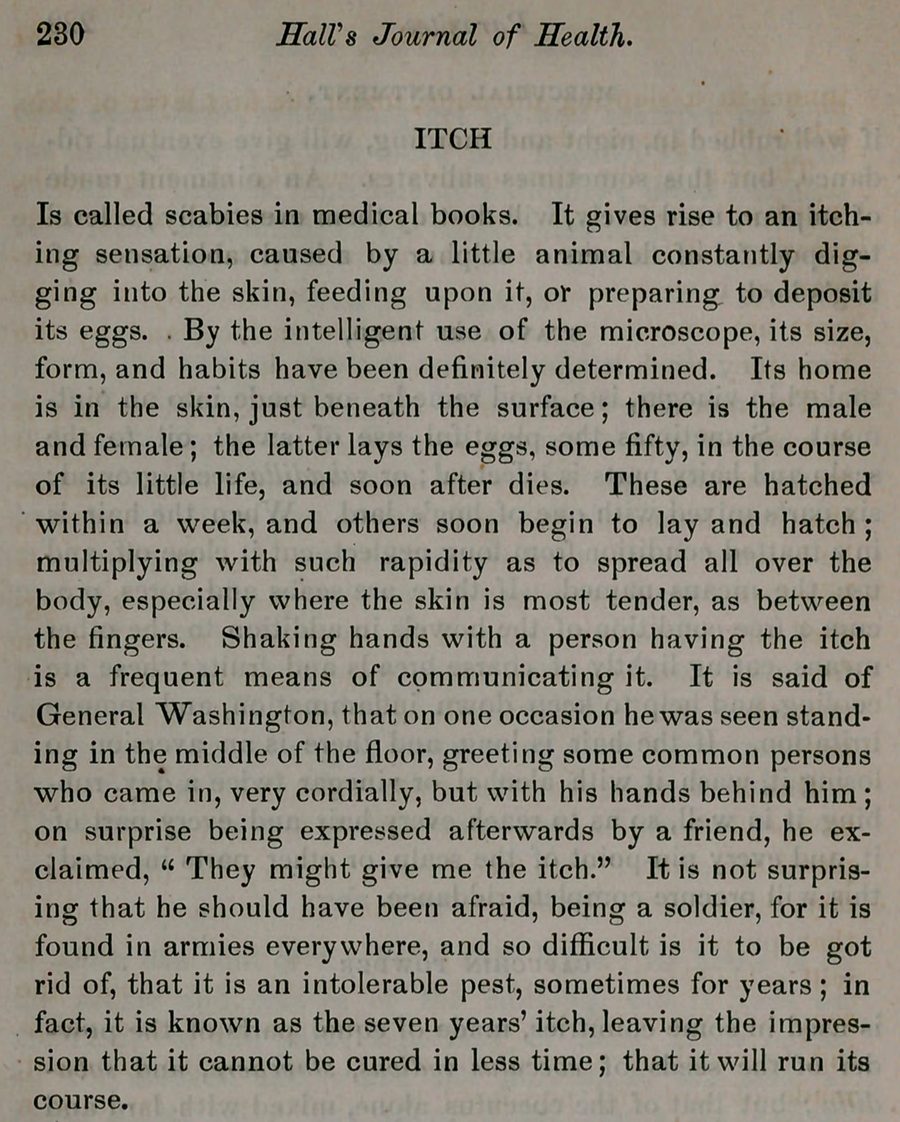
"Itch", Hall's Journal of Health, vol. 19, no. 10, October 1872, page 230. Via PubMed Central, Public Domain Mark.
The nice part comes a couple of paragraphs later, where the same article busts its own myth: "It is not true that there is a seven years' itch, nor a year's itch, meaning thereby that it has such a time to run its course". Soap, scrubbing and ointment would see it off.
The little animal had been drawn back in 1687, eggs and all, by Giovan Cosimo Bonomo in Florence. If this post has made you scratch, the NHS has a page on scabies.
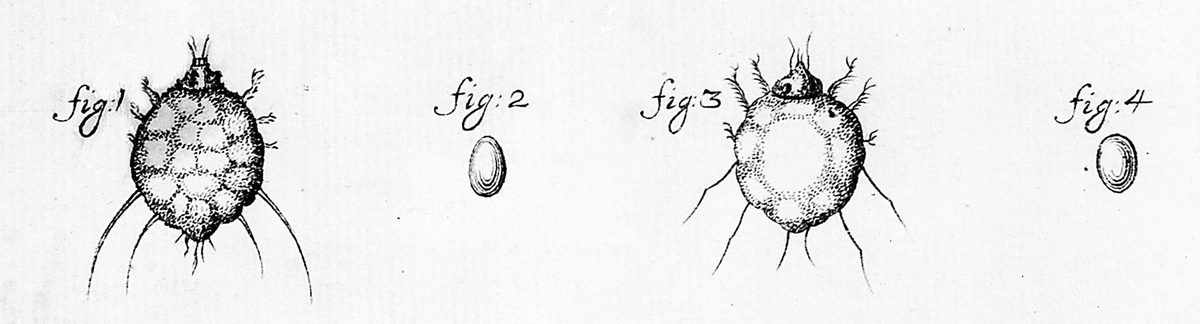
Illustration of Sarcoptes scabiei, the itch mite and its eggs, from Giovan Cosimo Bonomo's plate of 1687, engraved by Fran. Nacci. Wellcome Collection, Public Domain Mark.
Before it was a reason to stray, it was a reason to scratch.
1854: Thoreau borrows the phrase
By 1854 the phrase was familiar enough for Henry David Thoreau to use it as a figure of speech. Near the end of Walden he writes:
If we have had the seven-years' itch, we have not seen the seventeen-year locust yet in Concord.
Thoreau is not talking about a rash here, or about marriage. What the page shows is that the phrase was already ordinary enough to borrow, nearly a hundred years before anyone used it about husbands and wives.
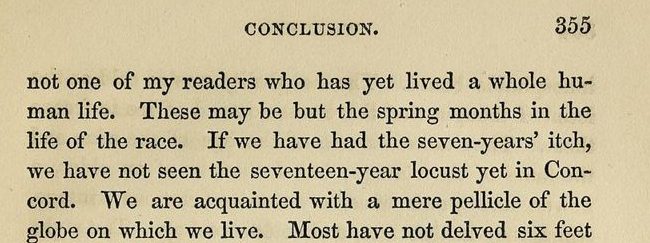
Henry D. Thoreau, Walden (Boston: Ticknor and Fields, 1854), page 355. Courtesy Smithsonian Libraries / Biodiversity Heritage Library, via the Internet Archive, not in copyright.
1913: "the most dangerous year"
The idea of a danger year in marriage is older than the phrase's marriage meaning. In 1913 the British writer Philip Gibbs wrote a whole book about it, The Eighth Year: A Vital Problem of Married Life. It opens with a line from a divorce court judge, Sir Francis Jeune, who presided over the Divorce Court from 1892 to 1905:
The Eighth Year is the most dangerous year in the adventure of marriage.
We only have that remark on Gibbs's word, printed eight years after Jeune died, and the book does not say when he said it. Gibbs also claims more than he shows: "By the law of averages and by undeniable statistics it has been proved that it brings many broken-hearted men and women to the Divorce Court." His own figures lump years five to ten together, so his book is an argument, not data. And he never calls it an itch.
Still, the eighth year of a marriage starts once seven years are done, which is much the moment the seven-year itch names today. So our "divorce court statistics" option is not as silly as it sounds. The phrase still did not come from statistics; it came from a rash.
1952: the playwright and the number
The marriage meaning turns up with George Axelrod's 1952 stage comedy The Seven Year Itch. He registered it for copyright on 6 August 1952 as "a romantic comedy in two acts".

Catalog of Copyright Entries, third series, vol. 6, Dramas, July to December 1952, page 100. US Copyright Office, via the Internet Archive, a US government work.
Forty years later, in 1992, Axelrod told William Safire of The New York Times where the title came from. He had been writing jokes for a radio comedian, Rod Brasfield, whose favourite line was "I know she's over 21 because she's had the seven-year itch four times!" At the time, Axelrod said, "it was a kind of nonmedical term for a skin disease", and it "had never been used in, to use your phrase, a 'marital wanderlust' connotation."
And then:
In the first draft, the guy had been married 10 years (as had I) but the title, when it came, had a natural ring to it and I changed the number of years the hero had been married accordingly.
So the seven was already in the phrase, and the hero's marriage was shortened to fit it. That is Axelrod's memory, forty years on, so take it as his account.
Billy Wilder's film version followed in 1955 and took the phrase worldwide. But the play got there first.
So is the itch real?
The latest figures from the Office for National Statistics, for England and Wales, cover 2024 and 2025. For opposite-sex couples, half the marriages ending in divorce had lasted longer than 13.0 years in 2025 (12.9 in 2024).
Year by year there is no sharp peak, more a flat plateau from about five to ten years. The most common length was 7 years in 2024 (5,367 divorces) and 6 years in 2025 (5,245), with the neighbouring years only a little behind each time. ONS counts completed years, so "7 years" means couples who divorced during their eighth year together.
So the data neither prove a seven-year itch nor debunk one.
What we're not claiming
- That 1839 is the first use. It is the oldest one we can stand behind. There are leads for earlier ones that we have not been able to check.
- That Axelrod invented the phrase. He borrowed it and gave it a new meaning.
- That anyone picked seven because it sounded good. The seven was in the phrase for over a century before the play.
- That nobody ever used it about marriage before 1952. No earlier example is known. One dictionary of slang dates a sexual sense to 1936, from a Carl Sandburg line that other word historians read as the rash.
- That Jeune's "eighth year" remark is confirmed. It rests on Gibbs's book alone.
- That the itch was always scabies. Usually, yes, but the name was used loosely for other itchy complaints too.
- That divorces peak at seven years. They don't, and they don't avoid seven either.
The original seven-year itch didn't make you leave. It just wouldn't leave you.
A note from us
We built Quiz Your Guests for our own wedding, and facts like these make good questions between the rounds about the couple. You can write your own multiple choice questions, one right answer and three wrong ones; guests scan a QR code, answer on their phones in two teams, and the scoring happens by itself. There is a printable wedding quiz too, if paper suits your day better.
More wedding myths
- Who started the white wedding dress?
- Where does the word honeymoon come from?
- Where does "Here Comes the Bride" come from?
- Why does the groom carry the bride over the threshold?
- Why did eloping couples race to Gretna Green?
- Where does "a month's salary on the ring" come from?
- Why were June brides said to be better off than May ones?
- Who came up with women proposing in a leap year?
- Why did so many couples marry in March?
- Why was the 1923 royal wedding not on the radio?
- Where does "Can't Help Falling in Love" come from?
Sources
- Michael Quinion, Seven-year itch, World Wide Words (quoting the Ohio Statesman, 26 March 1839, found by Stephen Goranson, and William Safire, "On Language", The New York Times, 29 March 1992)
- American Dialect Society mailing list, "Seven-year itch", July 2011, posts by Michael Quinion, Jonathan Lighter and Garson O'Toole (quoting Safire's column)
- "Itch", Hall's Journal of Health 19(10), October 1872, pp. 230 to 235, PubMed Central
- Henry D. Thoreau, Walden (Boston: Ticknor and Fields, 1854), p. 355, Internet Archive
- Philip Gibbs, The Eighth Year: A Vital Problem of Married Life (New York: Devin-Adair, 1913), Project Gutenberg
- Catalog of Copyright Entries, 1952, Dramas, p. 100, Internet Archive
- Giovan Cosimo Bonomo, plate of the itch mite (1687), Wellcome Collection
- Office for National Statistics, Divorces and dissolutions in England and Wales: 2024 and 2025 (23 September 2026), Tables 7 and 8, ONS divorce statistics. Contains public sector information licensed under the Open Government Licence v3.0
Skip the spreadsheet
Everything in this guide — timed rounds, team scoring, escalating points — is built into Quiz Your Guests. Answer four questions and your quiz arrives already written and scheduled around your day.
Ready to run yours?
Your quiz arrives written, themed and timed around your day — free to try, no signup needed.
Create your wedding quiz →Keep reading