
Why Did So Many Couples in England and Wales Marry in March?

In this guide
In the 1950s and 60s, March was the most popular month to get married in England and Wales. It came top every single year from 1950 to 1968, and the reason was income tax: a husband got the married man's allowance for the whole tax year, however late in it he married, and the tax year ended on 5 April. Today the top month is August (14.3% of weddings in 2023, according to the Office for National Statistics), and June, the obvious guess, did not come top in a single year of the ONS monthly figures from 1947 to 2011.
This is the long version of our "Wedding myths" video, with the numbers, the Chancellor's own words and the law that ended it.
The chart, decade by decade
The ONS has counted weddings in England and Wales month by month since 1947. In that first year August came top, followed by December and April. In 1948 it was March, in 1949 July. Then March took over and did not let go: it was the top month in every year from 1950 to 1968.
Across those 19 years, 18.2% of all weddings took place in March, more than twice June's 8.3%. The peak was 1957, when 76,244 of the year's 346,903 weddings were in March: 22.0%, more than one in five. March beat June every year, by 1.6 times (1950) to 2.7 times (1967); June never ranked higher than fourth. The usual runner-up was September.
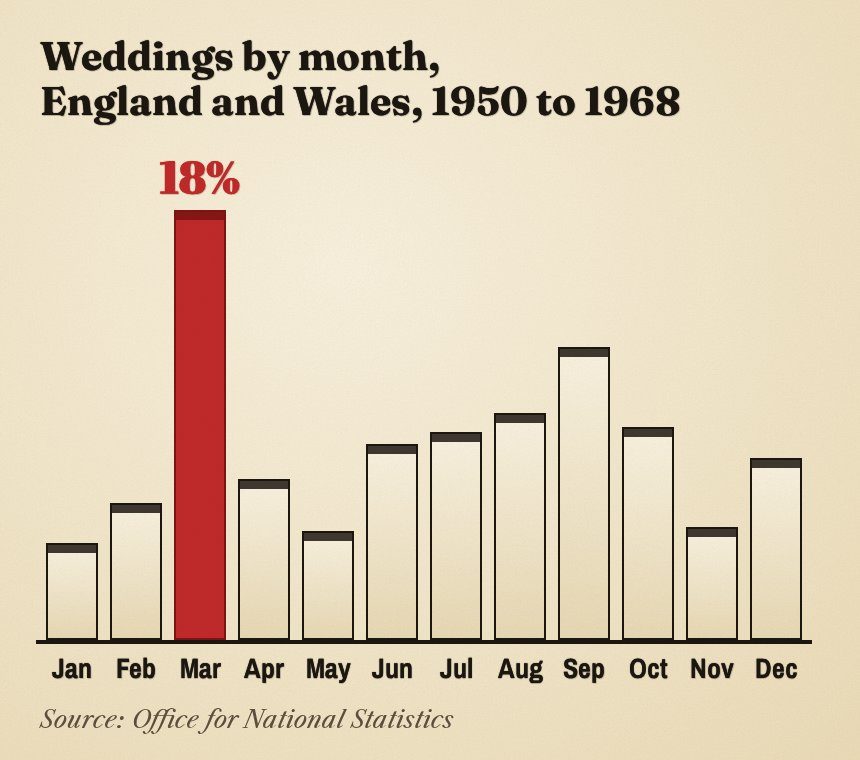
Weddings by month, England and Wales, 1950 to 1968, chart made by us (2026) from ONS Table 7. Source: Office for National Statistics, licensed under the Open Government Licence v3.0.
The top month year by year, from the same table:
| Year | Top month | Runner-up | March's share of the year | |---|---|---|---| | 1947 | August | December | 8.2% | | 1948 | March | July | 13.1% | | 1949 | July | June | 10.1% | | 1950 | March | September | 13.9% | | 1951 | March | September | 21.4% | | 1952 | March | August | 20.0% | | 1953 | March | August | 16.5% | | 1954 | March | July | 16.9% | | 1955 | March | July | 16.9% | | 1956 | March | September | 20.8% | | 1957 | March | August | 22.0% | | 1958 | March | August | 20.3% | | 1959 | March | September | 19.7% | | 1960 | March | September | 15.2% | | 1961 | March | September | 15.6% | | 1962 | March | September | 20.1% | | 1963 | March | September | 18.6% | | 1964 | March | September | 17.9% | | 1965 | March | September | 16.2% | | 1966 | March | October | 16.3% | | 1967 | March | September | 17.9% | | 1968 | March | September | 19.8% | | 1969 | August | September | 10.5% | | 1970 | August | September | 9.2% |
After 1969 the top spot went back to late summer: August, September or July every year to 2011, where the table ends.
Why March? The tax year
The tax year ended on 5 April, and the married man's allowance did not care when in that year you had married. The Income Tax Act 1952 gave the higher married relief to a man who could show "that for the year of assessment he has his wife living with him". Marry by 5 April, even in the last week of March, and a new husband got the married allowance for the whole year that was just ending.
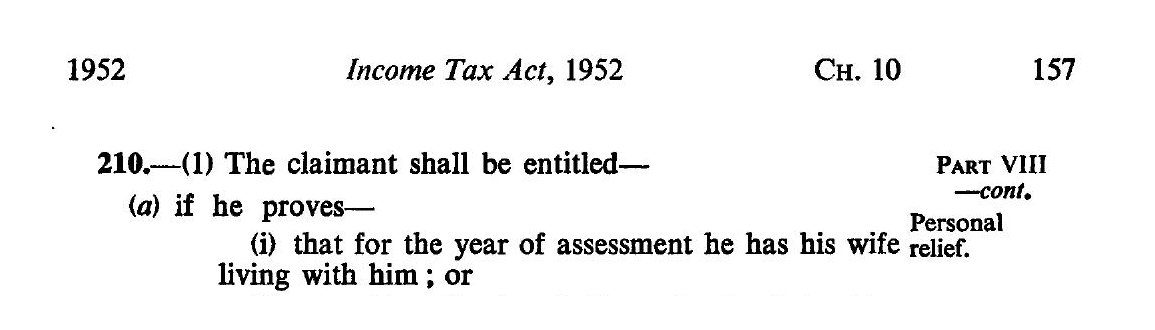
Income Tax Act 1952, c. 10, s. 210, printed p. 157, UK Parliament, 1952. Via legislation.gov.uk; contains public sector information licensed under the Open Government Licence v3.0.
The Chancellor said as much in the House of Commons in 1968: "At present the full marriage allowance is due, however late in the fiscal year the marriage takes place. There tends, in consequence, to be a spate of marriages as 6th April approaches, or in October if the wife is proposing to continue to work."
That last clause explains a smaller autumn peak in the 1960s, which the ONS says tax is "likely" to have caused too. In the data it falls in September, not October, in every year from 1960 to 1968 except 1966.
An academic study agrees. Gelardi (1996), a two-country study in the National Tax Journal that includes England and Wales, found, according to its abstract, "a relationship between the change in the law [and] the relative number of marriages that were performed near the tax year end".
19 March 1968: the Chancellor ends it
The Chancellor was Roy Jenkins, and he ended the loophole in his Budget speech on 19 March 1968, in March of all months. "I do not think it particularly appropriate that the accidents of the tax calendar should make so much difference to the tax position of a newly-married couple," he said. From 6 April that year, a husband would get the full allowance "only if he is married for the full year, which I define as meaning on or before 5th May. If he marries later in the year he will get only the appropriate monthly proportion."
He expected the change to "produce about £12 million in 1968-69, and £15 million for a full year". That was a forecast, not a measured saving.
The law: one-twelfth a month
It became law in the Finance Act 1968, which received Royal Assent on 26 July 1968. Section 14(2) says that for a man who marries during the year, the married relief is reduced "for each month of that year ending before the date of the marriage, by one-twelfth" of the amount by which it exceeds single relief. A "month" here runs from the 6th to the 5th, to match the tax year.
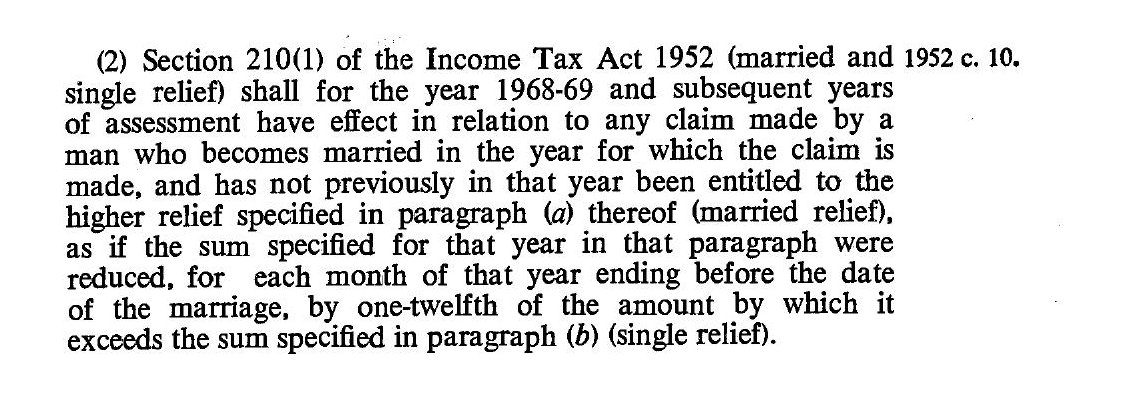
Finance Act 1968, c. 44, s. 14(2), printed p. 9, UK Parliament, 1968. Via legislation.gov.uk; contains public sector information licensed under the Open Government Licence v3.0.
So the tax break now only counted the months you were married. A March wedding no longer bought a whole year. It isn't the first time a law moved weddings around (ask the Gretna Green runaways), or money shaped a wedding custom (see the month's salary ring).
What happened next
In 1969, compared with 1968, March weddings fell by 48%, April rose by 84% and May by 97%. May had a little help: May 1969 had five Saturdays, one of them 3 May, inside the new full-allowance window, while May 1968 had four. March's fall has no such excuse, because March 1968 and March 1969 both had five Saturdays.
And August came top, just: 48,219 weddings to September's 48,132, a margin of 87. It was August's first win since 1947, helped perhaps by five Saturdays to September's four.
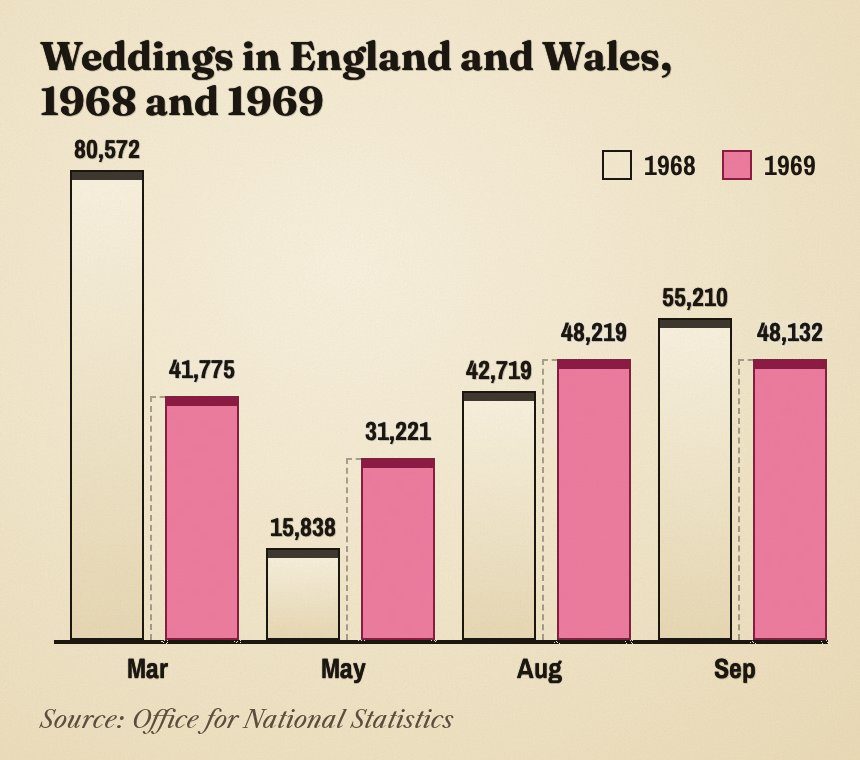
Weddings in England and Wales, 1968 and 1969, chart made by us (2026) from ONS Table 7. Source: Office for National Statistics, licensed under the Open Government Licence v3.0.
Why 1969 and not 1968? The new rule applied from 6 April 1968, but couples who had booked 1968 weddings before the 19 March Budget could not easily move them. 1969 was the first full year of dates chosen under the new rule.
That leaves March 1968 itself: 80,572 weddings, the most in any month since monthly records began in 1947. It is tempting to call it a last rush, but it had five Saturdays, 1968 was a big year (407,822 weddings, more than any year since 1947 up to then, though 1970 and 1972 were bigger), and by share of its year it ranks only seventh. The Budget came on 19 March, far too late to cause it.
Love was in the air, but the taxman was hot on its heels.
What we're not claiming
- That this was all of Britain. The figures are for England and Wales; we haven't checked Scotland's.
- That June was never popular anywhere. In the United States, June really was the mid-century peak.
- When the rule began. Jenkins said "at present" in 1968, and the 1952 Act consolidated older law. We don't know when the rule started.
- A cash bonus. An allowance is not money in hand. The gain was the tax saved on the extra allowance, and we haven't put a figure on it.
- That Easter explains it. March came top even in years when Easter fell in mid April: 1954, 1957, 1960, 1965 and 1968.
- That August "won the 60s". It came top in one year of the decade, 1969, by 87 weddings.
- That March 1968 was the biggest rush. It is the biggest month by count from 1947 to 2011, not by share, and we haven't checked 2012 onwards month by month.
A note from us
We built Quiz Your Guests for our own wedding, and facts like these make good questions between the rounds about the couple. You can write your own multiple choice questions, one right answer and three wrong ones (try "Which month had the most weddings in England and Wales in the 1950s and 60s?"); guests scan a QR code, answer on their phones in two teams, and the scoring happens by itself. There is a printable wedding quiz too, if paper suits your day better. For more ready-made questions, our wedding quiz questions for guests include the modern answer to this one, and there are plenty more in our fun and quirky wedding trivia.
More wedding myths
- Who started the white wedding dress?
- Where does the word honeymoon come from?
- Where does "Here Comes the Bride" come from?
- Why does the groom carry the bride over the threshold?
- Why did eloping couples race to Gretna Green?
- Where does "a month's salary on the ring" come from?
- Why were June brides said to be better off than May ones?
- Who came up with women proposing in a leap year?
- Where does the seven-year itch come from?
- Why was the 1923 royal wedding not on the radio?
- Where does "Can't Help Falling in Love" come from?
Sources
- Office for National Statistics, Number of marriages, marriage rates and period of occurrence, 2011 edition, Table 7, "Month of occurrence, 1947-2011" (Open Government Licence v3.0)
- Office for National Statistics, Marriages in England and Wales (provisional): 2023, released 18 November 2025
- Office for National Statistics, "Let's get married. OK, when?" and "Save the date"
- Hansard, HC Deb 19 March 1968 vol 761 c292, Apportionment of Marriage Allowance
- Income Tax Act 1952 (c. 10), s. 210, legislation.gov.uk
- Finance Act 1968 (c. 44), s. 14(2), legislation.gov.uk
- Gelardi, "The Influence of Tax Law Changes on the Timing of Marriages: A Two-Country Analysis", National Tax Journal 49(1), 1996, pp. 17-30, doi:10.1086/NTJ41789183 (abstract)
- National Center for Health Statistics, 100 Years of Marriage and Divorce Statistics, United States, 1867-1967 (1973), p. 3
Skip the spreadsheet
Everything in this guide — timed rounds, team scoring, escalating points — is built into Quiz Your Guests. Answer four questions and your quiz arrives already written and scheduled around your day.
Ready to run yours?
Your quiz arrives written, themed and timed around your day — free to try, no signup needed.
Create your wedding quiz →Keep reading