
Who Came Up With the Idea That Women Can Propose in a Leap Year?

In this guide
Nobody really knows. The custom that a woman may propose in a leap year is real and old, but where it began has never been pinned down. The famous answer, a law made by Queen Margaret of Scotland in 1288, has no record behind it, and the queen it names was a little girl living in Norway.
This is the long version of our "Wedding myths" video, with the five-year-old queen, the joke postcards and the queen who really did propose.
The story as it is usually told
In a leap year, the story goes, a woman may ask a man to marry her. In some versions the right covers the whole year; in others only 29 February. A man who says no has to pay up: a silk gown, or £100, or a pound, depending who tells it.
The most quoted version gives it a date and an author. Snopes sums it up: "Often this tidbit of misinformation was presented as a 1288 decree by Queen Margaret of Scotland, under which men who declined the invitation to wed were fined £100." It still turns up as fact, as "In 1288 the Scottish Parliament enacted the following law".
There is no record of any such law. Snopes calls it "widely and erroneously reported".
The queen was five, and lived in Bergen
Margaret, known as the Maid of Norway, was born in Tønsberg, on the coast of southern Norway, between March and 9 April 1283. Her father was King Eric II of Norway, and her grandfather was Alexander III of Scotland. When Alexander died in 1286, she became his heir. She was brought up in Bergen.
So on 29 February 1288 she was four. She turned five that spring.
She never ruled Scotland. She was never inaugurated, and as Wikipedia's article on her puts it, "her contemporaries in Scotland described her as queen very rarely, referring to her instead as their "lady"." Medievalists.net is blunter: she was "called Queen but was never crowned". Scotland was run by Guardians, who had a seal of their own.
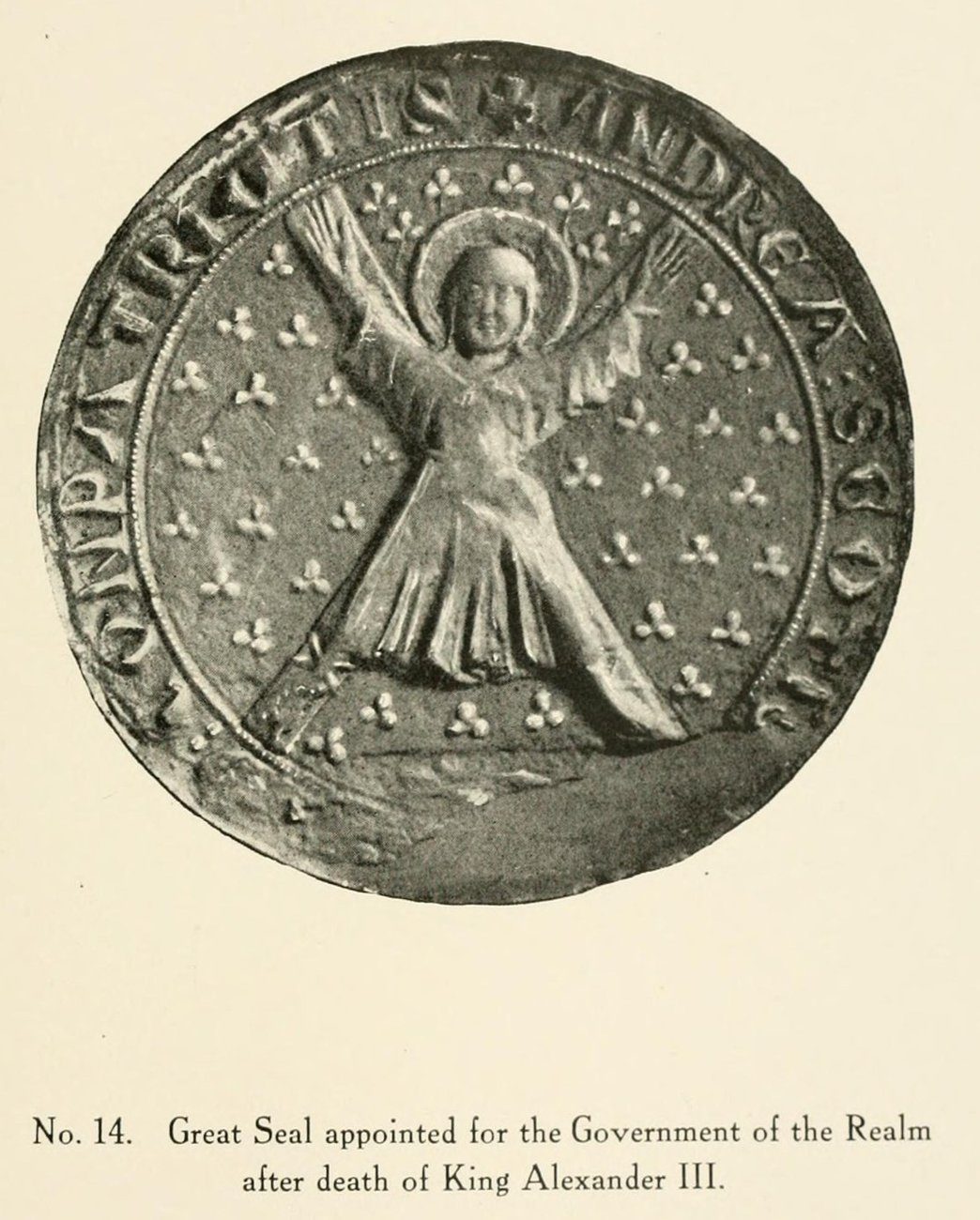
Great Seal appointed for the Government of the Realm after death of King Alexander III: the Guardians' seal of 1286, St Andrew side, plate No. 14 in W. de Gray Birch, History of Scottish Seals, vol. 1, 1905. Internet Archive, public domain. No portrait of Margaret exists.
Promised by treaty at seven
Her father and the Scottish leaders then negotiated her marriage to Edward of Caernarfon, the son of King Edward I of England. The marriage terms were set in the Treaty of Birgham on 18 July 1290. She was seven.
She did get a say, though. Under the earlier Treaty of Salisbury, in Wikipedia's words, "Margaret was allowed to choose her husband, though her father retained the right to veto the choice."
The marriage never happened. Margaret sailed for Britain in September 1290, fell ill on the way and died in Orkney, which was Norwegian then, between 26 and 29 September. She was seven, and she never reached Scotland.
So where does the custom come from?
Nobody knows. Snopes says "The origins of "The Ladies' Privilege" are not definitively known". The other story you will meet is set in Ireland, with St Brigid complaining to St Patrick; Snopes gives it only as "one posited beginning", and Vox calls both it and the Scottish queen false. The historian Amanda Foreman, writing about the origin stories, concludes: "Neither story is likely to be true." In the Irish telling, 29 February is Bachelor's Day (it is question 41 in our wedding quiz questions for guests).
What we can say is that the custom is older than the postcards. By then it had become a running joke. As Vox puts it: "By the early 1900s, a leap year was a common occasion for jokes about romantically aggressive women."
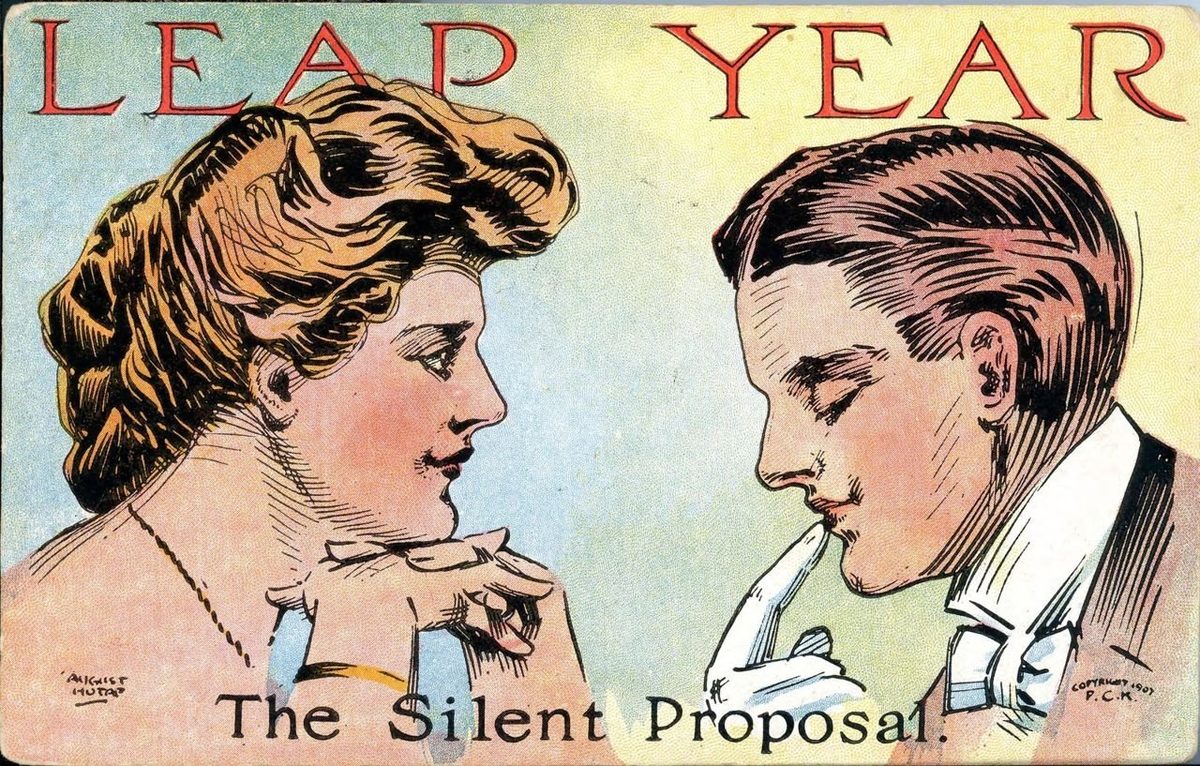
Leap Year: The Silent Proposal, August Hutaf, published by Paul C. Koeber Co., © 1907 (this copy was posted in June 1908; a pencilled name on it has been removed). Columbus Metropolitan Library, via Wikimedia Commons, public domain.

The joke was often on the men. In Bart's cartoon for the Minneapolis Journal in 1908, a vain old bachelor dreams that a young woman asks him to be hers, and wakes up in a sweat.
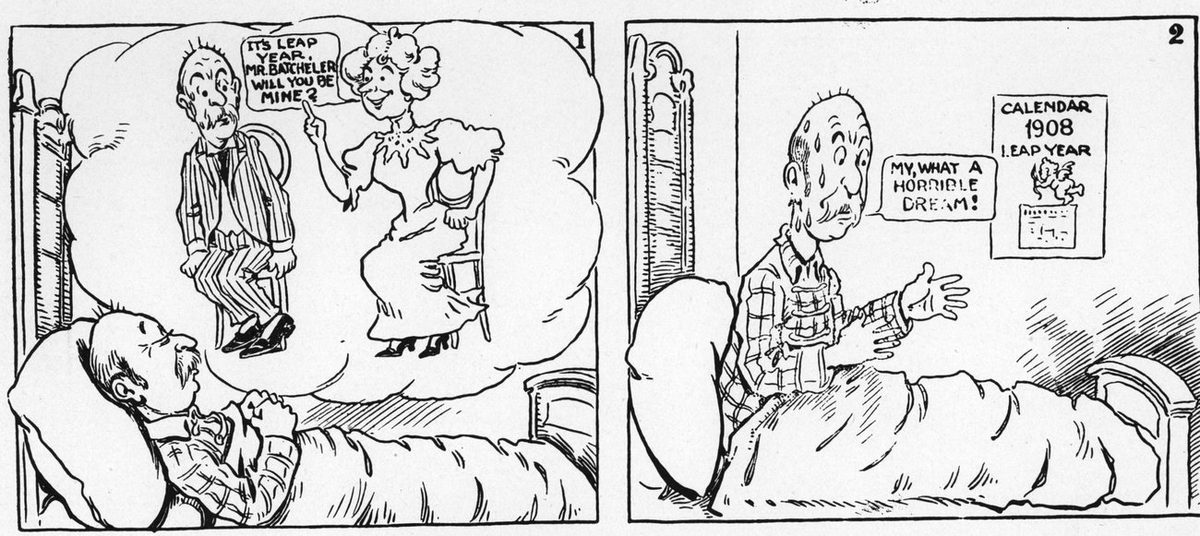
The Leap Year Experience of Mr. Batchelor, panels 1 and 2, C. L. Bartholomew ("Bart"), Minneapolis Journal, Sunday 10 May 1908. Hennepin County Library, via Wikimedia Commons, public domain.

The queen who really did propose
There is a queen in this story who proposed, and she had nothing to do with leap years. Victoria became queen in 1837, and as the London Museum explains, "according to tradition, no one could propose to a reigning monarch." Foreman puts it more strongly: "As a ruling monarch, it was Victoria's right and duty to make the proposal."
On 14 October 1839 she asked her prime minister, Lord Melbourne, how to go about it. Her journal, as printed in 1912, reads: "Then I asked, if I hadn't better tell Albert of my decision soon, in which Lord M. agreed. How? I asked, for that in general such things were done the other way". It made Lord Melbourne laugh.
The next day, Tuesday 15 October 1839, she sent for Albert and told him "that it would make me too happy if he would consent to what I wished (to marry me)." He accepted, and she wrote that "I really felt it was the happiest brightest moment in my life."
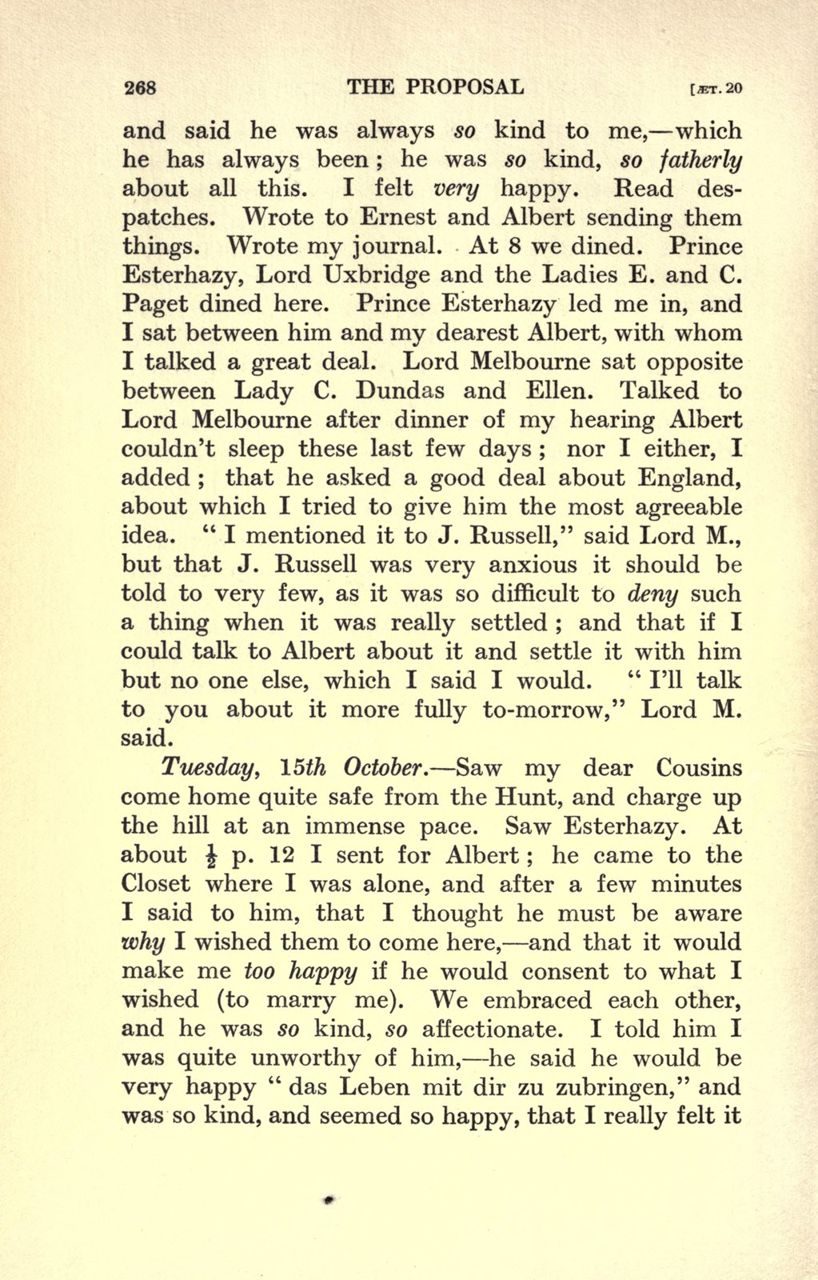
The Girlhood of Queen Victoria, vol. 2, p. 268, ed. Viscount Esher (John Murray, 1912): the entry for Tuesday 15 October 1839. University of Toronto copy, Internet Archive, public domain.
A Tuesday, in October, in 1839, which was not a leap year. No leap year required. Two weeks later, on 29 October, "Albert gave me a ring just like the one I gave him with the date of the 15th in it."
They married on 10 February 1840, which was a leap year, though the proposal had long since been made. That wedding has a myth of its own: who started the white wedding dress?
What we're not claiming
- That we know where the custom began. Nobody does. We don't say it started as a joke, or put a date on it. The postcard jokes came after it.
- That we have searched the Scottish records ourselves. Our sources call the 1288 law erroneous and unlikely; we say there is no record of it, and leave it there.
- That Margaret was five on 29 February 1288. She was four. She turned five that spring.
- That she was born in Bergen. She was born in Tønsberg and brought up in Bergen.
- That she never got to choose her husband. The Treaty of Salisbury said she could, subject to her father's veto. The marriage terms came later, at Birgham, in 1290.
- That the fine was a kiss. You will read that online. Our sources say a silk gown, £100 or a pound.
- That Victoria was the first or the only woman to propose. She is simply one we can read about in her own words.
A note from us
We built Quiz Your Guests for our own wedding, and facts like these make good questions between the rounds about the couple. You can write your own multiple choice questions, one right answer and three wrong ones; guests scan a QR code, answer on their phones in two teams, and the scoring happens by itself. There is a printable wedding quiz too, if paper suits your day better.
If you want to borrow this one: "Who came up with the idea that women can propose in a leap year? A Scottish queen, by law, in 1288; the makers of joke postcards; or nobody really knows?" Watch the table that picks the queen.
More wedding myths
- Who started the white wedding dress?
- Where does the word honeymoon come from?
- Where does "Here Comes the Bride" come from?
- Why does the groom carry the bride over the threshold?
- Why did eloping couples race to Gretna Green?
- Where does "a month's salary on the ring" come from?
- Why were June brides said to be better off than May ones?
- Where does the seven-year itch come from?
- Why did so many couples marry in March?
- Why was the 1923 royal wedding not on the radio?
- Where does "Can't Help Falling in Love" come from?
Sources
- Barbara and David Mikkelson, Snopes, "'Leap Day' Proposal" (2004), citing Simpson and Roud, Oxford Dictionary of English Folklore (Oxford University Press, 2000), p. 210
- Libby Nelson, Vox, "The strange history of sexist leap day traditions" (29 February 2016), for the early 1900s jokes
- Amanda Foreman, "Historically Speaking: Women Who Popped the Question", Wall Street Journal, 20 February 2020
- Wikipedia, Margaret, Maid of Norway (drawing on Oram, Duncan and Reid) and Treaty of Birgham
- Medievalists.net, on Margaret, Maid of Norway (Abernethy, 2014)
- London Museum, The marriage of Queen Victoria & Prince Albert
- Queen Victoria, The Girlhood of Queen Victoria, vol. 2, ed. Viscount Esher (John Murray, 1912), pp. 267, 268 to 269 and 273, Internet Archive
- W. de Gray Birch, History of Scottish Seals, vol. 1 (1905), plate No. 14, Internet Archive
- EBSCO Research Starters, "Leap Year" (2022), as an example of the 1288 law printed as fact
Skip the spreadsheet
Everything in this guide — timed rounds, team scoring, escalating points — is built into Quiz Your Guests. Answer four questions and your quiz arrives already written and scheduled around your day.
Ready to run yours?
Your quiz arrives written, themed and timed around your day — free to try, no signup needed.
Create your wedding quiz →Keep reading